Hotels and cinemas are no longer just places to sleep or watch a movie—they are increasingly high-stakes environments where every square foot of lobby space must earn its keep. That reality is driving a surge in demand for dual-screen kiosks, where one interactive panel handles customer transactions while a second, outward-facing display beams ads and information at passersby. Shenzhen-based manufacturer ZKTEK (SHENZHEN ZHONGKONG COMPUTERS CO., LTD.) is positioning itself as a primary supplier for this trend, arguing that the hardware solves a fundamental tension: how to process more people faster without adding clutter or sacrificing marketing opportunities.
Modern commercial service environments demand equipment that delivers efficiency, user convenience, and space optimization. Operators in hospitality, entertainment, and gastronomy face constant pressure to accelerate transactions without expanding physical footprints. In response, commercial venues increasingly turn to a reliable wholesale dual-screen kiosk factory to source specialized hardware that merges self-service functionality with high-impact dynamic messaging. Dual-purpose display systems eliminate bottlenecks by permitting simultaneity: customers perform self-guided check-ins, ticketing, or order settlements on one screen while the rear display communicates promotional material or public information. This structural approach optimizes customer throughput while providing a continuous platform for brand visibility.
Maximizing spatial efficiency and streamlining high-traffic workflows
Also worth a look: ESO Ventures pushes small business support beyond holiday shopping into year-round economic strategy and SUARDIAZ Group opens 100,000 m² Gijón RoRo terminal amid surging Asian vehicle imports.
Floor space in high-traffic commercial environments represents a premium operational asset. Traditional service configurations often force a trade-off between customer transaction points and promotional media displays. Dual-screen self-service hardware solves this operational friction by uniting both functions into a singular vertical footprint. By mounting an interactive user interface on the front alongside an outbound-facing advertising screen on the rear, businesses eliminate the need for separate digital signage units and dedicated service counters.
The dual-purpose display architecture seamlessly divides tasks across both panels. On the interactive front panel, users manage payment transactions, ticketing selections, keycard issuance, and menu navigation through an intuitive touch interface. Simultaneously, the rear display functions as an independent advertising panel, featuring high-brightness video streams, dynamic promotional loops, and real-time public information.
This integrated design directly targets congestion points in commercial lobbies. During peak hours, traditional single-screen devices only serve the immediate user, leaving waiting patrons without clear guidance or engagement. Dual-screen configurations continuously display queue statuses, venue maps, or scheduled events to surrounding foot traffic while the primary user completes a transaction. In environments such as busy hotel lobbies and cinema concourses, this dual-focus architecture increases overall throughput, maintains continuous orderly flow, and minimizes physical clutter without expanding the hardware profile.
Elevating user interaction and securing automated payment and ticketing flows
Smooth transaction flows depend heavily on hardware reliability and intuitive component layout. Self-service equipment must house sophisticated payment modules and verification tools within a streamlined, tamper-resistant enclosure. Modern dual-screen terminals combine touch panels with multi-currency bill acceptors, encrypted pin pads (EPP), barcode scanners, thermal printers, and automated card dispensers. Integrating these components into a unified system ensures that users complete complex check-in or purchase tasks without technical delays.
Security remains a primary consideration when processing automated financial payments and issuing physical credentials like hotel keycards or event tickets. Industrial-grade enclosures protect sensitive peripheral hardware while maintaining high accessibility for routine maintenance. Furthermore, specialized thermal printing units and high-speed card distribution mechanisms enable continuous operation during high-volume periods. By centralizing these payment and ticketing capabilities into a sturdy, ergonomic terminal, commercial venues establish dependable self-service points that maintain consistent performance standards under heavy daily use.
Unlocking ancillary revenue via synchronized dual-screen advertising
Beyond transactional efficiency, dual-screen hardware transforms standard point-of-sale locations into dynamic communication channels. Traditional interactive kiosks leave the screen idle or partially obscured while a customer performs an action. Dual-screen architecture solves this limitation by dedicating a secondary, high-brightness panel exclusively to outward messaging. Consequently, while a primary user navigates menus, the secondary screen targets passing foot traffic with video streams, promotional campaigns, or cross-selling offers.
This real-time dual operation creates secondary commercial value for venue operators. Commercial venues can run tailored advertisements for internal services, partner brands, or local events directly at high-traffic choke points. Furthermore, central content management platforms allow administrators to update dynamic displays remotely across multiple deployments. Instead of relying on static posters or separate signage displays, operators leverage synchronized dual screens to maintain brand consistency, generate advertising revenue, and increase customer awareness without incurring extra infrastructure costs.
Multi-scenario adaptability: hotels, cinemas, and restaurants
Dual-screen kiosks demonstrate clear operational versatility across distinct commercial sectors. Each business environment leverages the dual-purpose design to address specific operational bottlenecks and service demands.
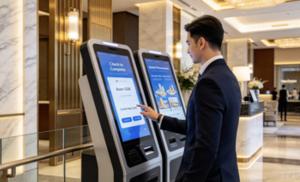
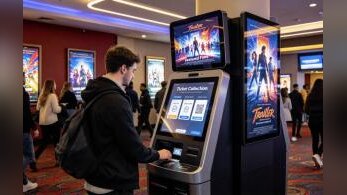
In hotel lobbies, terminals accelerate check-in and check-out procedures during busy arrival windows. The primary screen guides guests through identity verification, payment settlement, and room keycard generation. Simultaneously, the outbound display highlights hotel amenities, dining specials, spa services, or local tour packages to waiting guests. At cinema concourses, venues integrate ticket printing solutions to manage rush-hour box office lines. Moviegoers quickly scan booking codes and print admission tickets on the user-facing panel, while the rear display broadcasts upcoming movie trailers, concession combos, and membership promotions directly to crowd streams. Fast-casual restaurants utilize the same hardware to streamline meal ordering and bill payment, with customers browsing high-resolution menus on the primary touch display and the secondary screen presenting daily specials, promotional meal bundles, or order pickup numbers to surrounding diners.
Factory-direct customization, rigorous quality control, and global standards
Deploying self-service hardware across international markets requires strict adherence to international quality benchmarks and flexible manufacturing capabilities. Global commercial buyers choose to partner directly with established manufacturers like ZKTEK to ensure long-term hardware stability and structural reliability. Factory-direct relationships allow operators to customize component configurations, housing materials, screen dimensions, and branding elements to match exact site specifications.
The direct factory pipeline provides complete customization options for peripheral specifications, housing design, and custom branding elements. Rigorous quality testing includes thermal stress evaluation, continuous component burn-in testing, drop and impact tests, and signal integrity verification. Additionally, production adheres strictly to international compliance standards, including CE marking, FCC compliance, and RoHS standards. Sourcing directly from an established original equipment manufacturer provides buyers with reliable long-term spare parts availability, continuous technical support, and structural scalability across international deployment networks.
Why it matters: As physical venues compete for both speed and attention, the ability to combine a transaction terminal with an advertising billboard in a single footprint is becoming a competitive necessity rather than a luxury. For hotel and cinema operators, the choice of a factory-direct partner like ZKTEK directly affects not just queue management but also the potential to unlock new revenue streams from otherwise dead screen space—a shift that could redefine how lobbies and concourses are designed in the years ahead.
To explore full hardware specifications and customized dual-screen terminal solutions, visit https://www.zktek.com/.
ZKTEK
ZKTEK
email us here