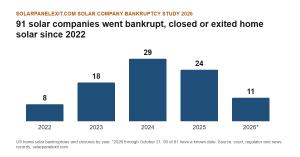
The numbers paint a sobering picture for anyone who has signed a residential solar contract in recent years: the company that sold you the system may vanish, but the loan almost certainly will not. A new study from SolarPanelExit.com documents at least 91 solar companies — spanning installers, lenders, lease providers, servicers, and equipment manufacturers — that have gone bankrupt, closed their doors, or abandoned the home solar market entirely between January 1, 2022, and October 21, 2026.
According to the SolarPanelExit.com Solar Company Bankruptcy Study 2026, 77 of those 91 companies (84.6%) entered a bankruptcy court or a similar legal proceeding. The remaining 14 simply closed or exited without leaving any court filing behind. The data draws from the site’s Solar Company Bankruptcy Register, a compilation built from court dockets, claims agent websites, securities filings, regulatory records, and news reports. Of the 91 entries, 72 include a specific court and case number, and 80 are cross-verified against at least one official docket, regulator, or multiple news outlets.
The pace of failures has been anything but steady. The study records just 8 collapses in 2022, rising to 18 in 2023, then peaking at 29 in 2024. That number eased to 24 in 2025, and so far this year, 11 cases have been recorded through October 21 — all of them court proceedings, with the total expected to climb as new filings appear in docket databases. One closure in the dataset has no known date.
When solar companies do land in bankruptcy court, the outcome is rarely a restructuring. Of the 77 court cases, 51 (66.2%) ended up in Chapter 7 liquidation: 41 companies filed for Chapter 7 directly, while 10 converted from Chapter 11. For the six converted cases where both filing dates are on record, the average time between a Chapter 11 filing and its conversion to Chapter 7 was just 118 days. Two notable examples include Freedom Forever, whose case was converted to Chapter 7 effective August 7, 2026 (Delaware bankruptcy court, case 26-10522), and North Bay Solar Electric, a California contractor that filed Chapter 7 on October 15, 2026 (Northern District of California bankruptcy court, case 26-10790).
Perhaps the most critical takeaway for homeowners is that the loan typically outlives the installer. In 36 entries tracked by the study, the customer’s loan or lease remained with the original lender or was transferred to a named servicer. For instance, SunStrong Management now services legacy Sunnova contracts for Solaris Assets, as well as legacy SunPower leases and power purchase agreements. Meanwhile, Solar Servicing LLC — a subsidiary of Forbright Bank — has handled former Solar Mosaic loans since September 22, 2025.
The fallout shows up in consumer complaint data as well. SolarPanelExit.com analyzed 1,705 Consumer Financial Protection Bureau (CFPB) complaints against six residential solar lenders and servicers. Complaints against Solar Mosaic jumped from 164 in the four quarters before its June 2025 bankruptcy filing to 467 in the four quarters after. Complaints against Sunnova rose from 23 to 50 over the same comparative periods. The CFPB does not verify the complaints, and the volume also reflects each company’s customer base.
Geographically, the failures are widespread. Texas leads with 19 companies tied to the state, followed by California with 18 and Florida with 13. In total, 40 states have at least one company on the list.
“Installers rarely hold the loans they sell, so when an installer goes bankrupt, the loan does not go away. It stays with the lender or moves to a new servicer,” said the SolarPanelExit.com Editorial Team. “We put the case number, the filing date and, where the record shows it, the current servicer in one place.”
Method and limits
The study counts companies tied to US home solar that, since January 1, 2022, filed for bankruptcy, entered a receivership, an assignment for the benefit of creditors or a foreign insolvency, or closed or exited residential solar. Two entries — ADT Solar and LG Electronics’ solar panel business — left home solar while still solvent. In 24 entries, a bankruptcy is confirmed but the company’s share of residential work is not; those are labeled accordingly. The count is a floor, because small installers often close with no court case or news story. Inclusion is based on public records and is not an allegation against any company. The full methodology, charts, and a free CSV download are available on the Solar Company Bankruptcy Statistics page.
About SolarPanelExit.com
SolarPanelExit.com publishes guides and public data for homeowners with solar contracts. The SolarPanelExit.com Editorial Team compiles the study, which is free to quote with credit and a link. SolarPanelExit.com earns referral fees when homeowners ask to be matched with solar contract exit companies; no company pays to be listed in or left out of the register. SolarPanelExit.com is not a law firm and does not give legal advice.
Editorial Team
Strive LeadGen
Visit us on social media:
LinkedIn
Facebook
YouTube
Why it matters
For homeowners, this study underscores a hard reality: a solar installation is only as reliable as the company behind the financing. As the industry shakeout continues, consumers must scrutinize not just the hardware, but who holds the loan and what happens if the installer disappears. The data suggests that the wave of solar company failures is far from over, and the financial obligations for customers are designed to persist long after the contractor is gone.