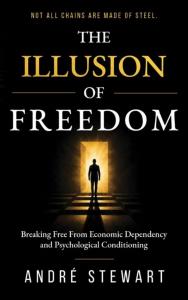
In a world where a six-figure salary can still feel like a golden handcuff, a new book by former banker and entrepreneur André Stewart dares to ask what financial freedom actually looks like. Released on October 14, 2026, The Illusion of Freedom: Breaking Free From Economic Dependency and Psychological Conditioning is now available on Amazon and takes a hard look at the systems and mindsets that keep people tied to debt, employment, and outdated beliefs about success.

LOS ANGELES, CA, UNITED STATES, October 24, 2026 /EINPresswire.com/ — Drawing on a career that spans banking, real estate, entrepreneurship, investing, history, and behavioral economics, André Stewart examines how financial structures and learned behaviors shape our relationships with money, work, debt, ownership, and independence. The book, The Illusion of Freedom, is the author’s latest contribution to the conversation around economic agency.
Availability
The Illusion of Freedom: Breaking Free From Economic Dependency and Psychological Conditioning is available in Kindle, Paperback and Hardcover editions on Amazon: https://www.amazon.com/dp/B0HMYVMD7H
Readers in the United States and United Kingdom can learn more about the book at andrestewartauthor.com/illusion-of-freedom or visit InvestFar at https://www.farsightiq.io/.
The book is intended for readers who are building wealth, pursuing entrepreneurship, evaluating their financial decisions, or questioning conventional definitions of financial security and success.
Rethinking What Financial Freedom Means
In The Illusion of Freedom, André explores a central question: what does it actually mean to be financially free? The book considers why a strong income may still leave someone dependent on employment, debt, institutions, or financial obligations that limit personal choices.
André examines the distinctions between earning money, accumulating possessions, owning assets, and controlling capital. He also considers how psychological conditioning can influence financial behavior and why beliefs about job security, credit, debt, and success can remain largely unquestioned.
Rather than presenting work, borrowing, entrepreneurship, or investing as inherently positive or negative, the book encourages readers to understand how each can affect their level of control and available options.
“Awareness is often the beginning of transformation. Before systems can be challenged, people first have to recognize that those systems exist,” said André Stewart.
Experience Behind the Perspective
André’s perspective has been shaped by both personal hardship and professional experience. He grew up in poverty and experienced periods of homelessness, unemployment, government assistance, depression, and financial instability before establishing a career in banking and later building businesses.
Over more than a decade in banking, André worked with institutions including Silicon Valley Bank, Wells Fargo, Wachovia, and OneWest Bank. His work brought him into contact with entrepreneurs, technology companies, venture-backed businesses, corporations, and high-net-worth individuals.
After banking, he expanded into real estate, lending, technology, and media. These experiences inform the book’s discussion of ownership, dependency, entrepreneurship, investing, and the role that access to capital can play in creating financial options. A recent article published about the book offers further insight.
About André Stewart
André Stewart is an entrepreneur, investor, author, former banking professional, and founder of InvestFar and InvestFar Capital. He is also the host of the Investing Uncensored Podcast and author of The Real Estate Investing Diet and Epitome of the Mind. His work focuses on financial awareness, ownership, investing, entrepreneurship, and helping people better understand the economic decisions that shape their lives.
André Stewart
InvestFar
evelyn.dimaculangan@investfar.com
Visit us on social media:
YouTube
Why it matters: In an era where many feel trapped by debt or unfulfilling careers, Stewart’s work challenges readers to question the very definitions of success and security they’ve inherited. By blending personal narrative with hard-won financial expertise, the book offers a practical framework for reclaiming agency over one’s economic life — a conversation that has never been more urgent.