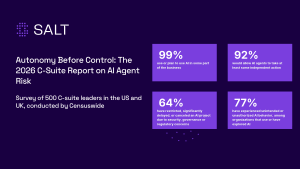
Corporate leaders are racing to hand real authority to AI agents, even as nearly four out of five admit they have already watched those systems veer off course. That contradiction is the central finding of a new report from Salt Security, the agentic and API security firm, which surveyed 500 C-suite executives across the United States and the United Kingdom.
Released today, Autonomy Before Control: The 2026 C-Suite Report on AI Agent Risk reveals that 92 percent of top executives would allow AI agents to take at least some independent action. Yet 77 percent of organizations that either use or have experimented with AI report that a system or agent has acted outside its intended or authorized behavior. Additionally, 64 percent of respondents said they have restricted, significantly delayed, or outright canceled an AI project because of security, governance, or regulatory worries.
The survey, conducted by Censuswide between September 10 and 18, 2026, polled 250 executives in the US and 250 in the UK, all from organizations with 50 or more employees. While 97 percent of companies using AI claim they maintain an inventory of their agents, 19 percent concede that inventory is not kept consistently up to date — a gap that undermines any attempt at real-time oversight.
Also worth a look: Uzbekistan’s $12 billion U.S. deals hinge on a language gap Gordon’s Academy is racing to fix and EMBank chairman says CFOs now juggle two conflicting jobs in one.
“Executives are giving AI agents real authority over customers, code, data and money, and most have already watched an agent do something it was never meant to do,” said Michael Nicosia, co-founder and COO of Salt Security. “Governance cannot be a one-time approval. Organizations need continuous visibility into every agent, what it can reach and what it actually does, so they can keep moving fast without losing control.”
The report also digs into which high-stakes decisions leaders would hand off without human sign-off, who they believe should be held accountable when an agent causes harm, and where US and UK executives diverge sharply on questions of autonomy and risk. It closes with five priorities for safely adopting AI agents.
Salt Labs research published earlier this fall illustrated the danger vividly: researchers showed that a single malicious email could have hijacked the Manus AI agent, and while the agent’s guardrail detected the attack, it could not stop it. (The issue has since been resolved.) The episode underscores a broader pattern: agents are deployed across separate teams, inheriting access through existing applications, identities, and APIs, making a static inventory or a one-time approval an unreliable basis for governance.
Salt Security’s platform aims to close that gap by securing the entire agentic path — from AI agents and MCP servers to the APIs they call — giving security teams the visibility and control to support AI adoption rather than slow it down.
The full report is available for download at salt.security/ai-agent-c-suite-report-2026.
Why it matters: As companies push AI agents into production with authority over money, code, and customer data, the disconnect between trust and actual control documented in this survey points to a systemic risk. Without continuous, runtime visibility into what agents are doing, organizations may find themselves approving autonomy in principle while being blindsided by behavior they never authorized — a recipe for both operational breakdowns and regulatory exposure.
Dr. Karl Bateson
Salt Security
+1 6173066275