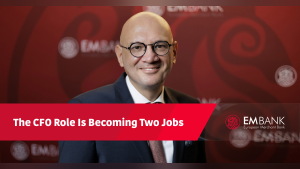
For chief financial officers across industries, the job description is quietly splitting in two — and the tension between the halves is becoming the central challenge of the role. That is the core argument from Ekmel Çilingir, Chairman of the Supervisory Board at European Merchant Bank (EMBank), who published a new article examining how CFO responsibilities are expanding well beyond traditional financial oversight.
In a piece titled “The CFO Role Is Becoming Two Jobs”, Çilingir lays out a stark reality: CFOs are now expected to combine financial stewardship with a second mandate — helping organisations interpret change, set priorities and make decisions under uncertainty. The article, released from Vilnius, Lithuania on November 20, 2026, paints a picture of a finance function under growing internal pressure.
CFOs still bear the weight of reporting, liquidity, controls, compliance and the disciplined use of capital. Yet at the same time, they are increasingly pulled into strategy, investment decisions and wider management discussions. “In practice, one role now carries two mandates,” Çilingir writes.
Also worth a look: Uzbekistan’s $12 billion U.S. deals hinge on a language gap Gordon’s Academy is racing to fix and Salt Security survey: 92% of execs trust AI agents to act solo, but 77% have seen them go rogue.
He defines the first mandate as stewardship — covering accuracy, control, liquidity, compliance and risk. The second is strategic navigation, which demands that finance leaders interpret incomplete information and advise management when the correct course of action is not immediately clear. The difficulty, according to Çilingir, stems less from the sheer volume of work than from the mental gymnastics required to switch repeatedly between two fundamentally different modes of thinking. “Financial control rewards consistency and precision, while strategic decision making often depends on judgement and a willingness to act before all information is available,” he notes. “The CFO is asked to protect the organisation from avoidable risk while helping it take the right ones.”
This transformation, Çilingir argues, cannot be shouldered by the CFO alone. As reporting and routine analysis become increasingly automated, wider finance teams are being asked to interpret financial data in a broader commercial and operational context. That shift demands knowledge of business priorities, technology and operational constraints in addition to traditional accounting expertise.
Artificial intelligence is expected to accelerate that transition. Çilingir suggests that AI will increasingly take over reconciliations, forecasting, monitoring and first-pass analysis, pushing the value of finance professionals toward judgement. “When analysis becomes cheap, the scarce skill is deciding which output deserves attention, which assumption is fragile and how much confidence a conclusion really warrants,” he writes. He adds that accountability remains with the finance leader, regardless of how much analytical work is automated. “The CFO of the future will spend less time producing answers and more time deciding which answers matter.”
Rather than splitting stewardship and strategy into two separate roles, Çilingir argues that organisations should structure their finance teams to support both responsibilities. He points to stronger deputies for reporting and control, finance business partners working more closely with operational teams, and protected time for longer-term thinking as practical responses. The article concludes that organisations need to reconsider how they support senior finance leaders rather than simply piling more expectations onto the position. “The organisations that get the most from their finance leaders will be those that stop expecting one person to do both unaided, and start designing the function to support each,” Çilingir writes.
Why it matters: As artificial intelligence automates the mechanical side of finance, the CFO role is becoming a test of judgment, not just calculation. Companies that fail to redesign their finance functions to support this dual mandate risk burning out their top financial talent and making poorer decisions under uncertainty. The real takeaway is not that CFOs need to work harder — it is that the entire finance team needs to be rebuilt around two distinct jobs, not one.
About Ekmel Çilingir
Ekmel Çilingir is the Chairman of the Supervisory Board at EMBank and an internationally recognised banking and fintech executive with extensive experience in payments, digital banking, financial innovation, and cross-border financial services.
About EMBank
EMBank, headquartered in Vilnius, Lithuania, is a digital-first bank focused on delivering innovative banking solutions to fintechs and Lithuanian businesses.
You can read the full article here: https://em.bank/blog/thought-leadership/the-cfo-role-is-becoming-two-jobs/
Gerda Šiatkutė
European Merchant Bank (EMBank)