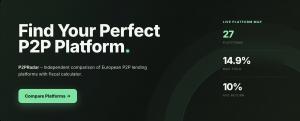
As the European Union’s crowdfunding regulations approach their fifth anniversary on November 10, new independent data reveals a stark regulatory divide between two common peer-to-peer lending models. According to P2PRadar, an independent comparison website, 9 out of 10 marketplace-style platforms in its public table hold an EU-level authorization, while only 2 out of 12 platforms that lend through their own group companies can say the same. This classification, based on 25 euro-denominated platforms as of October 23, 2026, suggests that the business model a platform adopts may be a strong indicator of its regulatory status.
Based in Camaiore, Lucca, Italy, P2PRadar reports that across all 25 platforms it tracks, 13 hold an EU-level authorization. Of these, eight are registered as European Crowdfunding Service Providers (ECSP) under Regulation (EU) 2020/1503, while the remaining five operate under the Markets in Financial Instruments Directive II (MiFID II). Two platforms hold national licenses, and ten hold no license of any of these three types. The breakdown by lending model is particularly telling: marketplaces, where independent lenders list loans on the platform, account for 10 of the 25 platforms, and nine of them are EU-authorized. In contrast, the 12 in-house lenders—where the platform’s own group provides or originates the loans—include only two with EU authorization, two with national licenses, and eight with no license at all. Three platforms combine both models, and two of those are EU-authorized.
The full classification, complete with definitions and a downloadable dataset, is available in the License Tracker. P2PRadar’s published methodology scores each platform on four weighted factors: trust and transparency (35 percent), track record (30 percent), operating maturity (20 percent), and governance and controversies (15 percent). In the current table, marketplaces average 72 out of 100, platforms combining both models average 68, and in-house lenders average just 43. Because regulatory status is one input to the trust factor, part of that gap comes from the method itself. However, license status is not a definitive verdict: two platforms without any license score 70 or higher, while the lowest-scoring EU-authorized platform scores 44.
The methodology also states that high advertised returns, bonuses, signup promotions, and affiliate status do not raise a score, and that a higher score is not capital protection. The table includes a capital-at-risk line, which P2PRadar describes as a speculative-risk warning and not an accusation.
“Yield is the easiest number to compare and the least informative,” said Francesco Navari, founder of P2PRadar. “Before the rate, investors can ask two questions: who lends, and who supervises. In this table, the answers are linked.”
A license register shows who is authorized, but it does not by itself reveal whether loans come from independent lenders or from the platform’s own group. To bridge that gap, P2PRadar suggests three checks before comparing rates: whether the platform appears in the register of authorized crowdfunding service providers kept by the European Securities and Markets Authority (ESMA), or in a national register for MiFID II firms; whether the lender is independent of the platform; and what the platform publishes about defaults and recoveries over several years.
“A license is a starting point, not protection,” Navari said. “It shows who supervises the platform. It does not remove the risk that the lender, or the platform’s own group, cannot repay.”
P2PRadar discloses that some links on the site are affiliate links and that it may receive a commission from a partner platform when a reader registers or invests through them, at no extra cost to the reader. Not every listed platform is a partner, and the site states that affiliate status does not raise a score. The site is informational and does not provide personalized financial advice.
Investing in P2P lending carries risk, including partial or total loss of the capital invested, and returns are not guaranteed. The figures in this release reflect P2PRadar’s own classification and scores as of October 23, 2026, and may change as platforms and regulators update their information.
About P2PRadar
P2PRadar (https://p2pradar.app) is an independent informational project on European P2P lending, operated by Francesco Navari as a sole proprietorship in Camaiore, Italy. The site offers a comparison table, platform reviews, articles, calculators, and tax guides for retail investors, in 12 languages. Navari is available for interviews on license status and lending models in European P2P lending.
Francesco Navari
P2PRadar
francesco@p2pradar.app
Why it matters: This data highlights that regulatory oversight in European P2P lending is far from uniform, and the business model—marketplace versus in-house lending—appears to be a major factor in whether a platform holds an EU license. For retail investors, this means that a platform’s structure and regulatory status should be among the first checks before committing capital, not an afterthought to advertised returns.