Getting Recommended by AI LLMs
See what LLMs say about your company or products
A pre-registered study demonstrated that 92% of AI product recommendations matched the locations the tool had predicted before any models were queried
“Every AI already has a belief about your company and has filed your products on a shelf before anyone asks it anything, and it has always been invisible.
— Lian Pham, Co-founder, Metrisque”— Lian PhamSAN FRANCISCO, CA, UNITED STATES, September 6, 2026 /EINPresswire.com/ — Metrisque has announced a measurement tool that reveals how AI models classify a company’s brand, products, and services, returning identical results each time it queries an LLM.
Asking an AI assistant the identical shopping question twice typically produces different product names, making AI visibility nearly impossible to gauge. Because LLMs shift their output with every query, a company can never determine whether a change it made actually influenced results or if the model simply answered differently that day.
Metrisque takes a different approach. Rather than measuring how often a brand appears in AI responses, it evaluates how closely a company’s own language aligns with the queries buyers use. This reading remains stable, so any adjustment can be implemented, measured, and validated.
Validation through research
In a pre-registered study assigned a permanent DOI (10.5281/zenodo.21417361), roughly 1,100 real recommendations from two leading AI models were tested against forecasts made before any model was asked a question. Ninety-two percent of those recommendations landed exactly where predicted.
"We also published the prediction we got wrong. A company that only shows you its wins hasn't shown you anything."
— Lian Pham, Co-founder, Metrisque
What Metrisque measures
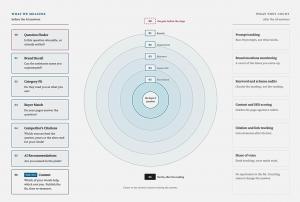
Metrisque captures six insights that companies cannot obtain through any other method.
Brand Recall reveals what AI models already believe about a company with no context open, whether they know it exists, and whether that knowledge is accurate. This pre-existing belief is formed before any question is asked and determines the answers a company never sees.
Category Fit shows how AI models classify both a company and its individual products. Knowing a brand is not the same as correctly shelving each product. For instance, one beauty brand’s makeup set was categorized by an AI model as a bug-collecting kit because the phrasing—a collection, gotta catch them all—suggested catching creatures. The company was understood perfectly, but the product ended up on the wrong shelf entirely. Metrisque reveals the actual shelf where each item is placed.
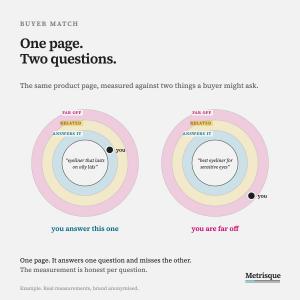
Buyer Match measures whether a company’s language corresponds to the questions buyers are asking. There are dozens of ways to request the same thing, and chasing every variation is endless—people invent new phrasing daily. Metrisque focuses on the one constant: whether the company’s words can be reached from the buyer’s intended meaning, regardless of how they typed it.
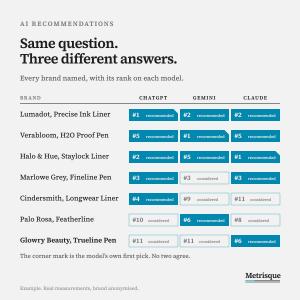
AI Recommendations shows which entities are mentioned when a buyer asks, and where a company ranks relative to them. Before answering, a model considers a longer list of candidates. A company may be on that list yet still not be named. Metrisque captures both: whether a company is in the running at all and how it compares to every other candidate being weighed.
Competitor's Citations identifies which websites each AI model actually reads when answering a buyer’s question, and which of those already mention the company. The models do not all read the same web—of 46 sources cited for a single question, only one was cited by all three models, and 39 were cited by just one model. Being covered in the right place for one model does nothing for the others.
Question Finder determines which buyer question is worth competing for. The same question may appear settled to one tool and wide open to another—what a model recalls from memory, what it retrieves by searching, and what it weighs before answering can each point to a different leader. Metrisque reads all three and reveals whether a question is open, contested, or already dominated, before a company invests anything to win it.
Why other measurements are inconsistent.
Metrisque’s own research demonstrates how much variation exists between runs.
Ask three leading AI models the same buyer question, and they will read almost entirely different sets of websites. Of 46 sources cited for one question, only one was cited by all three. Thirty-nine were cited by a single model. Being visible to one AI says almost nothing about the others.
Ask the same model the same question days apart, and roughly 60% of the websites it reads will have changed.
The market context.
“Every channel that mattered got placed and had a measurement layer before it got a budget. Search and social also had one. AI answers didn’t have one given the speed at which things moved and the money is already moving. Companies can’t tell whether it worked, and agencies are carrying the risk of that answer.”
— Lian Pham, Co-founder
Feedback from a pilot customer.
“Two of the three AIs didn’t know who we were, and the one that did had us categorized as something we don’t sell. That was not a marketing problem; it was a much earlier problem, and we couldn’t see it until we measured it. We changed one page, measured it again, and the number moved.”
— Rosmon Sidhik, Co-founder, The F* Word, pilot customer
Availability.
Metrisque is now accessible at metrisque.com, allowing companies to calibrate their own visibility posture or that of their products and services.
Nitin Kumar
Metrisque, by Telesuite
+1 408-915-8627
email us here
Visit us on social media:
LinkedIn