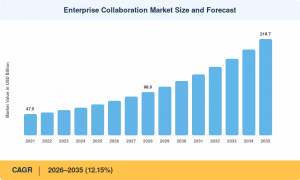
The Enterprise Collaboration Market is gaining momentum as organizations implement cloud-based platforms, unified communication tools, AI capabilities, and digital workplace solutions.
Enterprise collaboration is evolving through AI-powered communication, cloud platforms, and integrated workflows that improve productivity, engagement, and teamwork”— Market Research FutureBERLIN, BERLIN, GERMANY, August 12, 2026 /EINPresswire.com/ — Enterprise collaboration has moved well beyond basic email and video calls, now functioning as a connective layer that unifies messaging, conferencing, document co-authoring, and increasingly AI-driven knowledge tasks within a single digital workplace. With hybrid work becoming a permanent operational model rather than a temporary pandemic response, organizations are consolidating the diverse collection of point tools they assembled over recent years into unified platforms designed to accelerate workflows and reduce licensing expenses.
The worldwide Enterprise Collaboration Market was valued at USD 69.50 Billion in 2025 and is anticipated to reach USD 77.95 Billion in 2026, eventually growing to USD 218.70 Billion by 2035, reflecting a CAGR of 12.15% over the 2026–2035 projection period. Two key forces are driving this growth: organization-wide initiatives to streamline fragmented communication systems, and significant investment in generative-AI copilots that are redefining what collaboration software can accomplish. Companies are no longer questioning whether to upgrade their collaboration infrastructure—they are competing on how quickly they can roll it out.
The core technological shift replaces isolated email threads, separate conferencing subscriptions, and disjointed file-sharing services with integrated platforms that combine voice, video, messaging, and knowledge management into a single interface. Enterprises that have adopted unified collaboration ecosystems report notably faster workflow cycle times and lower internal-tool licensing expenses—a value proposition bolstered by government-supported digital-infrastructure programs such as the EU’s Digital Decade initiative, which aims to promote widespread cloud adoption among European SMEs by 2030.
Get a Sample PDF of the Report at —
https://www.marketresearchfuture.com/sample_request/8018
Market Dynamics: Drivers, Restraints and Opportunities
Generative-AI copilot integration stands out as one of the most powerful short-term drivers of the Enterprise Collaboration Market. Microsoft’s Copilot for Microsoft 365 exceeded 400,000 paying enterprise seats within its first year of general availability, and competitors have quickly followed suit—Google introduced Duet AI across Workspace, while Salesforce embedded Einstein GPT into Slack workflows.
AI copilots are transforming collaboration from reactive communication to proactive knowledge synthesis, and vendors are capitalizing on this by offering premium per-seat tiers with significant price increases over base licenses. Hybrid and remote work policies are further accelerating this momentum: research indicates that a majority of U.S. knowledge workers now operate under structured hybrid arrangements, a sharp increase from just a few years ago, while France’s telecommuting accord and Germany’s proposed home-office legislation are making collaboration-tool provisioning a formal employer requirement.
Cloud migration is also speeding up, driven less by cost savings than by the AI-compute demands of modern collaboration features—real-time transcription, meeting summarization, and intelligent search all require elastic, GPU-backed processing that on-premise data centers struggle to provide affordably. The expansion of 5G adds further momentum, with global connections projected to surpass 5.5 billion by 2030, enabling low-latency applications such as real-time AR-assisted remote support and instant video conferencing from field locations where fixed broadband access remains limited.
Nevertheless, the market faces real obstacles. Data privacy and security issues are significant, as collaboration platforms are increasingly targeted as vectors for credential phishing and lateral movement, with the average cost of a data breach now reaching millions of dollars. Enterprises in regulated industries encounter additional compliance burdens when routing sensitive data through third-party collaboration clouds, prompting some to postpone migration or maintain costly parallel on-premise systems.
Legacy-system integration complexity remains another persistent challenge: many organizations run three or more collaboration platforms simultaneously, creating data silos and redundant licensing costs, while failed integration attempts are a leading reason CIOs cite for stalled consolidation projects. Vendor lock-in risk, tighter IT budgets amid macroeconomic uncertainty, and digital fatigue among users add further headwinds.
These pressures also create significant opportunities. AI-powered meeting intelligence and workflow automation drew over a billion dollars in venture capital in recent years, and the potential extends well beyond transcription to automated action-item extraction, sentiment analysis, and cross-platform workflow triggers that major vendors are racing to implement. Data-sovereignty regulations—including GDPR, the EU Data Act, and India’s Digital Personal Data Protection Act—are fueling demand for jurisdiction-specific collaboration environments, particularly in healthcare, defense, and financial services, opening a niche for vendors offering regionally hosted, compliance-certified platforms.
Emerging-market digital workforce expansion represents another greenfield opportunity, as tens of millions of new digital-economy jobs are expected across Sub-Saharan Africa, South Asia, and Southeast Asia by 2030, each requiring collaborative tools designed for low-bandwidth, mobile-first conditions. Immersive and spatial collaboration is also moving from prototype to pilot, with enterprise AR/VR headset shipments forecast to rise sharply by the end of the decade.
Key Players and Competitive Insights
The Enterprise Collaboration Market exhibits medium concentration, with the top five players holding an estimated revenue share of 52% to 58%. Microsoft maintains clear leadership through its Teams-Office 365 ecosystem, while Cisco, Google, Salesforce, and Zoom compete in the next tier. The competitive focus is shifting from feature comparisons to AI-integration depth, ecosystem breadth, and compliance-certification coverage, with smaller pure-play vendors instead focusing on vertical specialization.
Leading companies in the global Enterprise Collaboration Market include Microsoft, Cisco, Alphabet (Google), Salesforce, Zoom Video Communications, Atlassian, RingCentral, SAP, Dropbox, and Avaya. Microsoft anchors the market as a full-stack ecosystem leader through Teams, Office 365, Viva, and Copilot. Cisco brings a network-native collaboration angle via Webex Suite and Thousand Eyes, while Alphabet positions Workspace, Duet AI, and Meet as a cloud-native, AI-first productivity offering.
Salesforce integrates Slack and Einstein GPT tightly with its CRM stack, and Zoom continues to build out Zoom Workplace and its AI Companion around a video-centric unified platform. Atlassian remains focused on developer and project-management workflows through Jira, Confluence, and Loom, while RingCentral, SAP, Dropbox, and Avaya round out the competitive field with UCaaS convergence, ERP-embedded collaboration, content specialization, and legacy telephony migration, respectively.
Buy this Premium Research Report at –
https://www.marketresearchfuture.com/checkout?currency=one_user-USD&report_id=8018
Market Segmentations
By Component
● Solutions
● Services
By Type
● Asynchronous
● Synchronous
By Organization Size
● Large Enterprises
● SMEs
By Deployment
● Cloud
● On-Premise
By Vertical
● BFSI
● IT & Telecommunications
● Retail
● Healthcare
● Travel & Hospitality
● Transportation & Logistics
● Government
● Energy & Utilities
● Education
● Others
By Region
● North America
● Europe
● Asia-Pacific
● South America
● Middle East & Africa
Regional Insights
North America commands roughly 36.8% of the Enterprise Collaboration Market, driven by early AI adoption and deep SaaS penetration. The United States accounts for the vast majority of regional revenue, fueled by hyperscale ecosystem alignment and federal AI mandates that accelerated FedRAMP-authorized collaboration deployments across defense and civilian agencies, while Canada’s Digital Charter Implementation Act is reshaping privacy expectations for cross-border platform usage and Mexico’s growth is largely tied to nearshoring-driven workforce digitization.
Europe holds the second-largest position at approximately a 27.2% share, shaped by the tension between cloud scalability and data-sovereignty mandates. The EU Data Act’s interoperability obligations favor open-standard collaboration platforms over proprietary walled gardens, and Germany’s manufacturing-heavy Mittelstand is a bellwether for layering team messaging onto existing ERP ecosystems, while France’s telecommuting labor-code mandates and Italy’s PNRR digital-transformation funding continue to anchor regional demand.
Asia-Pacific is the fastest-growing region, expanding at roughly 14.7% CAGR through 2035, propelled by 5G rollouts and aggressive digitization policies across India, China, and ASEAN economies. China’s domestic collaboration giants collectively serve hundreds of millions of enterprise users, India’s Digital India program has onboarded millions of SMEs onto cloud platforms since 2022, and South Korea’s K-Cloud initiative is targeting extensive public-sector cloud adoption by 2028. South America and the Middle East & Africa remain smaller in absolute terms but are growing quickly, led by Brazil’s banking-sector digitization and Saudi Arabia’s Vision 2030 digital-government push.
Browse A Full Report: (Including Full TOC, List Of Tables & Figures, and Chart) –
https://www.marketresearchfuture.com/reports/enterprise-collaboration-market-8018
Recent Developments
Vendors have been racing to embed generative AI more deeply into their collaboration stacks. Salesforce introduced Slack AI for enterprise customers, featuring native channel summarization and thread-search intelligence trained on organizational data, while Atlassian completed the migration of all Jira and Confluence customers to the cloud, ending server-license sales and consolidating its user base onto a single infrastructure. RingCentral partnered with Meta to integrate WhatsApp Business messaging into RingCentral MVP, targeting emerging-market enterprise communication workflows.
On the regulatory front, the European Commission published technical standards for the EU Data Act’s interoperability requirements, directly affecting collaboration-platform vendors serving European enterprises. Microsoft’s Copilot for Microsoft 365 continued its rapid seat growth, generating a substantial increase in incremental annual recurring revenue, and hyperscalers more broadly continued investing in sovereign-cloud regions and compliance certifications such as FedRAMP High and ISO 27701 to satisfy the most cautious procurement teams in regulated industries.
Frequently Asked Questions (FAQs)
Q1. What is the expected growth of the Enterprise Collaboration Market?
The market is projected to grow at a CAGR of 12.15% from 2026 to 2035, reaching about USD 218.70 billion by 2035.
Q2. What factors are driving the Enterprise Collaboration Market?
Generative-AI copilot integration, hybrid and remote work mandates, cloud migration acceleration, and 5G rollouts are major growth drivers.
Q3. Which region dominates the Enterprise Collaboration Market?
North America currently leads with roughly 36.8% of global revenue share, driven by early AI adoption and deep SaaS penetration.
Q4. What are the major challenges facing the market?
Data privacy and security concerns, legacy-system integration complexity, vendor lock-in risk, and IT budget constraints remain key challenges.
Q5. Which segment holds the largest market share?
Software led the component segment with 66.35% revenue share in 2025, while Services is the faster-growing segment at a 15.20% CAGR.
Q6. Who are the leading companies in the Enterprise Collaboration Market?
Major players include Microsoft, Cisco, Alphabet (Google), Salesforce, Zoom Video Communications, and Atlassian.
➤➤ Regional & Country-Level Reports by Market Research Future:
Japan Enterprise Collaboration Market –
https://www.marketresearchfuture.com/reports/japan-enterprise-collaboration-market-59775
North America Enterprise Collaboration Market –
https://www.marketresearchfuture.com/reports/north-america-enterprise-collaboration-market-59776
South America Enterprise Collaboration Market –
https://www.marketresearchfuture.com/reports/south-america-enterprise-collaboration-market-59777
Europe Enterprise Collaboration Market –
https://www.marketresearchfuture.com/reports/europe-enterprise-collaboration-market-59778
India Enterprise Collaboration Market –
https://www.marketresearchfuture.com/reports/india-enterprise-collaboration-market-59779
China Enterprise Collaboration Market –
https://www.marketresearchfuture.com/reports/china-enterprise-collaboration-market-59780
US Enterprise Collaboration Market –
https://www.marketresearchfuture.com/reports/us-enterprise-collaboration-market-14909
➤ Featured Insights from Market Research Future:
Insight Engines Market –
<a href="https://www.marketresearchfuture.com/reports/insight-