The numbers are hard to ignore: the global digital out-of-home (DOOH) advertising market is projected to hit roughly $26.5 billion in 2026, expanding at a compound annual growth rate of 10.7% through 2030. For commercial property developers, transit operators, municipal authorities, and retail facility managers, this represents a major opportunity — but only if they can deploy the right hardware. Rather than relying on static posters or struggling with the high upfront costs of custom installations, many venue operators are turning to a wholesale advertising kiosk sourced directly from China to capture that revenue stream.
Chinese manufacturer ZKTEK (SHENZHEN ZHONGKONG COMPUTERS CO., LTD.) is positioning itself as a key partner in this shift. The company offers specialized commercial display hardware designed to turn heavy foot traffic into sustainable, recurring ad income across both indoor and outdoor environments. By sourcing directly from original equipment manufacturers, commercial network operators can avoid unsustainable capital expenditure while deploying scalable, high-brightness displays.
Architectural Segmentation: Matching Display Hardware to Environmental Demand
Also worth a look: ESO Ventures pushes small business support beyond holiday shopping into year-round economic strategy and SUARDIAZ Group opens 100,000 m² Gijón RoRo terminal amid surging Asian vehicle imports.
Not all advertising networks face the same conditions. A high-traffic indoor shopping mall demands different visual interaction mechanics than an exposed outdoor transit plaza or a temporary event space. Ambient lighting, space restrictions, structural loads, and user interaction requirements all dictate the right hardware profile.
Commercial display solutions generally fall into three functional tiers:
- Indoor Retail Deployments: Operators prioritize dual-screen setups with touch interaction on the front and dynamic marketing content on the rear, keeping a compact vertical footprint for tight walkways.
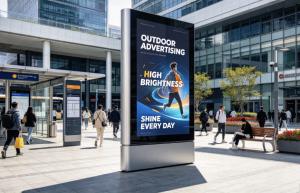
- Outdoor Transit and Street Environments: Equipment requires high-brightness panels delivering 2,000 or more nits, housed inside IP65 weatherproof enclosures with automated climate management systems.
- Temporary Event Operations: Mobile setups use battery-powered LED configurations mounted on heavy-duty wheels to support rapid deployment without fixed electrical infrastructure.
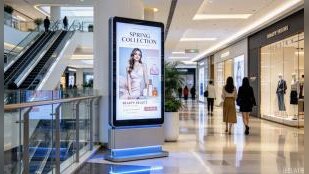
In controlled indoor retail environments, commercial operators favor dual-screen architecture. Terminals featuring interactive touch panels on the front, paired with secondary promotional panels on the rear, maximize spatial efficiency in narrow mall corridors and store entrances. Conversely, semi-outdoor and fully exposed outdoor locations demand heavy-duty structural engineering. Outdoor displays need LED and LCD panels ranging from 1,500 to over 2,500 nits to maintain clear visibility under direct sunlight. For temporary marketing pop-ups, food festivals, and outdoor concerts, mobile battery-powered display units that eliminate reliance on external power outlets deliver high-impact visual performance.
Engineering for Outdoor Environments: Thermal Management, Enclosure Ratings, and Sunlight Readability
Hardware operating in unconditioned outdoor environments faces extreme temperature swings, rain, snow, dust, and direct solar radiation. Ensuring continuous 24/7 display operation requires robust thermal management systems and ruggedized enclosures. Standard indoor screens fail quickly under direct sun due to internal heat buildup and backlight fading, leading to permanent liquid crystal damage, black spots, and downtime.
Engineers address these challenges by combining high-brightness industrial panels with advanced optical bonding and anti-glare tempered glass. Optical bonding reduces internal light reflection, increasing contrast ratios and sunlight readability even in intense high-ambient-light conditions. Outdoor hardware also uses IP65-rated weatherproof enclosures that prevent water ingress and airborne dust contamination. Integrated intelligent climate control systems — featuring automated cooling fans and heating elements — regulate internal enclosure temperatures across extreme seasonal cycles. These safeguards protect internal electronics, preserve component longevity, and maintain stable visual output.
Strategic Placement and Revenue Optimization Across Diverse Footprint Scenarios
Maximizing advertising yield depends on strategic hardware placement, traffic density, and alignment with consumer dwell times. Commercial operators deploy specific screen configurations across three primary venue categories:
- Shopping Malls and Retail Arcades: Indoor retail hubs leverage dual-screen terminals, such as the HD4 dual screen advertising terminal, placed along high-density walkways, escalator hubs, and food court entrances. The primary screen offers interactive store directory navigation and wayfinding services, while the rear display streams continuous video advertising to passing shoppers.
- Transit Hubs and Municipal Plazas: Bus terminals, train stations, ferry piers, and public plazas deploy rugged outdoor multi-touch digital signage networks, including the W1, W3, W5, and WD5 outdoor kiosk series. Placed near passenger waiting areas and ticketing gates, these high-brightness displays broadcast dynamic arrival schedules alongside localized programmatic advertisement loops.
- Outdoor Venues and Event Pop-Ups: Event organizers, stadium operators, and street venues use portable, battery-powered outdoor displays, such as the YW10 mobile LED signage system. Equipped with built-in rechargeable battery packs and rugged castor wheels, these flexible units allow operators to position promotional displays rapidly at concert gates, outdoor markets, and sporting events without complex cable infrastructure.
Sourcing Direct from China: Cost Efficiency, Customization, and Manufacturing Standards
Building a scalable, multi-location DOOH network requires significant capital investment in hardware. Procurement teams achieve superior return on investment by establishing direct manufacturing partnerships with established factory exporters in China. Sourcing directly eliminates intermediate distributor markups and regional agency surcharges, allowing network operators to deploy larger display fleets within fixed budget parameters.
Direct factory collaboration also provides comprehensive customization flexibility across both hardware and software tiers. Commercial buyers work alongside engineering teams to tailor housing dimensions, custom color schemes, peripheral integrations, and screen configurations to precise site requirements. Established manufacturing partners like ZKTEK execute rigorous quality control protocols across all assembly stages. Production lines conduct thermal stress testing, vibration analysis, panel burn-in procedures, and ingress protection validation prior to global shipment. Full compliance with international standards, including CE, FCC, and RoHS certifications, ensures smooth regulatory approval and reliable long-term performance across global deployment destinations.
Why it matters: The DOOH market’s rapid growth means that static signage is no longer enough for property owners and transit agencies looking to monetize high-traffic spaces. By partnering with manufacturers like ZKTEK that offer direct sourcing, customization, and ruggedized hardware, operators can build resilient digital signage infrastructure that turns physical foot traffic into a consistent, recurring ad revenue stream — without the overhead of traditional middlemen.
ZKTEK
ZKTEK
email us here