Rail is quietly becoming one of the most consequential battlegrounds in global infrastructure, and new data shows just how much money is flowing into it. A fresh outlook from The Business Research Company projects that the rolling stock market — the locomotives, passenger coaches, and freight wagons that keep trains moving — will balloon to $91.49 billion by 2030, driven by urbanization, green transport mandates, and a wave of government-funded rail projects.
That figure represents a compound annual growth rate of 7%, according to the firm’s newly released Rolling Stock Global Market Report 2026 – Market Size, Trends, And Forecast 2026-2035. The segment accounts for roughly 42% of the broader locomotives, wagons, and other rolling stock industry, which is on pace to hit nearly $218 billion by the same year. Within the massive Transport industry — projected to reach $9,400 billion by 2030 — rolling stock will hold just under 1% of total value.
LONDON, GREATER LONDON, UNITED KINGDOM, October 13, 2026 /EINPresswire.com/ — The momentum behind rolling stock reflects a broader shift in how cities and nations are thinking about mobility. As urban populations swell and freight volumes climb, rail infrastructure is being positioned as a solution to congestion and emissions alike. The result is a sector that is attracting serious capital and technological attention, with rolling stock industry players racing to meet demand.
Market Size and Growth Trajectory
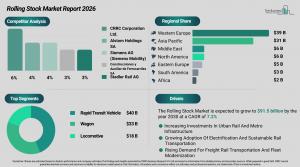
By 2030, the market is expected to surpass $91 billion, with Western Europe emerging as the largest regional hub. CRRC Corporation Ltd. led the pack in 2025 with a 6% market share, while the top ten companies together controlled 28% of the market. The growth is not uniform, however — it is being propelled by distinct forces, each contributing a measurable slice of the annual expansion.
Request A Free Sample Of The Rolling Stock Market Report
https://thebusinessresearchcompany.com/sample_request?id=6028&type=smp&name=Rolling%20Stock%20Market%20Report%202026&utm_source=EINPresswire&utm_medium=Paid&utm_campaign=Oct_PR
What’s Driving Expansion
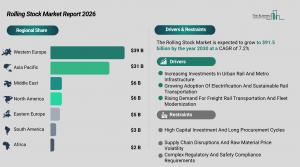
Government spending on urban rail and metro systems is the primary catalyst. Cities around the world are pouring money into metro, suburban, high-speed, and light rail projects to relieve traffic congestion and serve growing populations. That infrastructure push is generating demand for new locomotives, passenger coaches, metro vehicles, and maintenance fleets — while also forcing the replacement of aging stock. These investments alone are expected to add roughly 2.4% annual growth to the market.
The environmental angle is just as significant. Operators are moving away from diesel-powered fleets and toward electric, battery, hybrid, and hydrogen trains to cut emissions and boost energy efficiency. Innovations like regenerative braking, lightweight construction, and improved propulsion systems are reinforcing these sustainability goals, contributing about 2.3% in annual market growth.
Access The Detailed Rolling Stock Market Report Here
https://thebusinessresearchcompany.com/report/rolling-stock-global-market-report?utm_source=EINPresswire&utm_medium=Paid&utm_campaign=Oct_PR
Freight rail is another pillar of growth. Rising shipment volumes of bulk goods, agricultural products, vehicles, chemicals, and intermodal cargo are pushing operators to invest in advanced wagons and locomotives equipped with predictive maintenance technologies, IoT monitoring, automation, and upgraded safety features. This segment is expected to add approximately 2.2% in yearly growth.
Segment Breakdown
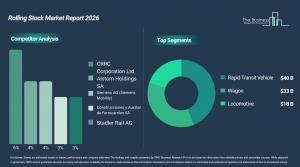
The market is divided into locomotives, rapid transit vehicles, and wagons. Rapid transit vehicles are forecast to dominate by 2030, capturing 44% of the market — around $40 billion. That growth tracks with rising urban populations, metro system expansions, and the adoption of lighter, more efficient designs. Further segmentation covers locomotive technologies such as diesel, electric, and electro-diesel models, as well as components like pantographs, axles, wheelsets, traction motors, and auxiliary power systems. End users are split between passenger transit services and cargo trains.
Regional Leaders
Western Europe is expected to remain the largest regional market by 2030, valued at $39 billion, up from $28 billion in 2025 — a 7% CAGR. The region’s strength comes from extensive rail electrification, fleet renewals, and public funding for sustainable transport. China is set to be the largest single country market, growing from $12 billion in 2025 to $16 billion by 2030 at a 6% CAGR, supported by new high-speed rail corridors and urban metro investments.
Competitive Landscape
The market is moderately fragmented, with the top ten companies holding 28% of revenue in 2025. Heavy capital requirements, complex engineering, strict safety regulations, and the need for extensive service networks shape this structure. Leading firms maintain their positions through comprehensive portfolios, long-term contracts, and innovation in high-speed and urban transit technologies.
The top companies and their market shares in 2025 include:
1. CRRC Corporation Ltd. – 6%
2. Alstom Holdings SA – 4%
3. Siemens AG (Siemens Mobility) – 4%
4. Construcciones y Auxiliar de Ferrocarriles SA – 3%
5. Stadler Rail AG – 3%
6. Kawasaki Heavy Industries Ltd. – 2%
7. Hyundai Rotem Company – 2%
8. Hitachi Rail Inc. (Hitachi Ltd.) – 2%
9. Wabtec Corporation – 1%
10. Greenbrier Companies Inc. – 1%
Innovation in Action
New metro train technologies are reshaping urban rail by improving efficiency and passenger comfort. In January 2026, Alstom landed a contract to deliver 70 New Subway Train (NST) Metropolis six-car trainsets to Toronto’s transit commission. These trains feature smart technologies, energy-saving systems, improved accessibility, and intelligent propulsion — advances that boost network reliability and encourage broader adoption of next-generation rolling stock.
Opportunities Through 2030
Rapid transit vehicles, wagons, and locomotives are the most promising growth areas, collectively expected to add more than $26 billion in value by 2030. Rapid transit vehicles alone are projected to grow by $12 billion, wagons by $9 billion, and locomotives by $5 billion between 2025 and 2030. Autonomous train operation, digitally connected rolling stock for predictive maintenance, and lightweight designs are among the key drivers.
Manufacturer Strategies
Leading companies are focusing on:
– Manufacturing products with recyclable and eco-friendly materials
– Incorporating lightweight composites to boost efficiency
– Embedding digital technologies for intelligent monitoring and maintenance
– Forming strategic collaborations for high-speed rail and urban transit
– Innovating energy-efficient and autonomous rolling stock
Key Players and Ecosystem
Major players include CRRC Corporation Ltd., Alstom Holdings SA, Siemens AG (Siemens Mobility), Construcciones y Auxiliar de Ferrocarriles SA, Stadler Rail AG, Kawasaki Heavy Industries Ltd., Hyundai Rotem Company, Hitachi Rail Inc. (Hitachi Ltd.), Wabtec Corporation, Greenbrier Companies Inc., Caterpillar Inc., MAPNA Group, Nippon Sharyo Ltd., Trinity Industries Inc., Talgo SA, Skoda Transportation AS, NEWAG S.A., PESA Bydgoszcz S.A., Transmash Holding, and Tatravagónka a.s.
The ecosystem also includes raw material suppliers such as Tata Steel, ArcelorMittal, Nippon Steel Corporation, Thyssenkrupp AG, voestalpine AG, POSCO, Novelis Inc., Alcoa Corporation, Norsk Hydro ASA, Rio Tinto, BHP, BASF SE, Covestro AG, Saint-Gobain, 3M, Toray Industries, Huntsman Corporation, Evonik Industries, DuPont, and Solvay. Wholesalers and distributors like Wabtec Corporation, Knorr-Bremse AG, Siemens Mobility, Hitachi Rail, ABB, Schneider Electric, Eaton Corporation, Sonepar, Rexel, RS Group, Motion Industries, Grainger, Fastenal, MSC Industrial Supply, Graybar Electric, Wesco International, Anixter, Allied Electronics & Automation, Farnell, and TTI Inc. play a crucial role. End users span major railway operators worldwide, including Deutsche Bahn AG, SNCF Group, Indian Railways, China Railway Corporation, Japan Railways Group, MTR Corporation, Canadian National Railway, Union Pacific Railroad, BNSF Railway, Russian Railways, Trenitalia, Renfe Operadora, Network Rail, Amtrak, Metro Trains Melbourne, Transport for London, São Paulo Metro, Singapore Mass Rapid Transit, Sydney Trains, and Dubai Metro.
New additions to the 2026 reports include:
• Market attractiveness scoring and analysis
• Total addressable market (TAM) analysis
• Company scoring matrix graphics and tables
• Excel-based forecasting dashboards
• Market hotspots infographics
• Key technologies and future trend analysis
• Updated graphics and tables
Learn More About The Business Research Company
The Business Research Company (www.thebusinessresearchcompany.com) is a market intelligence firm that has published over 30,000+ reports across 27 industries and 60+ geographies. Its research draws on 1,500,000 datasets, extensive secondary research, and exclusive insights from interviews with industry leaders.
The firm offers continuous and custom research services, including Market Entry Research Package, Competitor Tracking Package, Supplier & Distributor Package, and more.
Disclaimer: The findings, conclusions, and recommendations that TBRC Business Research Pvt Ltd delivers are based on information gathered in good faith from both primary and secondary sources, whose accuracy is not always guaranteed. As such, TBRC Business Research Pvt Ltd accepts no liability for actions taken based on information that may subsequently prove incorrect. Analysis and findings in TBRC reports are estimates and opinions, not statements of fact or investment guidance.
Contact Us:
The Business Research Company
Americas +1 310-496-7795
Europe +44 7882 955267
Asia & Others +44 7882 955267 & +91 8897263534
Email: marketing@tbrc.info
Follow Us On:
LinkedIn: https://in.linkedin.com/company/the-business-research-company
Oliver Guirdham
The Business Research Company
+44 7882 955267
info@tbrc.info
Visit us on social media:
LinkedIn
Facebook
X
Why it matters: As governments commit to rail as a cornerstone of sustainable transport, the companies that build and modernize rolling stock are positioned to benefit from a decade of steady growth. The shift toward electric and autonomous trains is not just an environmental story — it is a commercial one, with billions in value at stake for manufacturers, suppliers, and the operators who depend on them.