
For high-net-worth investors juggling cross-border business commitments, South Korea’s investment residency route is less about simply buying property and more about navigating a strict web of fund compliance, re-entry schedules, and legal scrutiny. A new breakdown from Globevisa Group sheds light on how the F-2 and F-5 visa tracks actually function in practice, and why most applicants never leave their home-country operations behind.
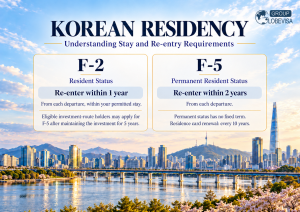
Globevisa outlines South Korea’s F-5 investment visa rules, focusing on residency requirements, fund compliance, and legal due diligence frameworks.
For investors looking to pair ongoing business interests with an overseas residency foothold, the South Korea investment immigration program comes with defined physical-presence rules, minimum capital commitments, source-of-funds checks, and a heavy documentation load. Since its South Korea desk opened in 2013, Globevisa Group has walked applicants through these routes. The firm’s internal data shows that more than 90% of the 1,300-plus families it has helped secure South Korean residency still run their primary businesses back home—a sign that the program is being used as a flexibility tool, not a relocation mandate.
Residency Rules for F-2 and F-5 Visas
The public business investment immigration scheme in South Korea splits applicants into standard and high-tier categories, which map to the F-2 resident visa and the F-5 permanent resident visa, respectively. Each tier carries its own acquisition path and ongoing maintenance obligations.
●F-2 Resident Stage: Holders of the F-2 registration card must enter South Korea at least once per year. After maintaining the qualifying investment for five years, they can apply to upgrade to F-5 permanent residency. The gap between a departure in one year and re-entry the next cannot exceed one year—and this applies regardless of which part of South Korea is entered.
●F-5 Permanent Resident Stage: Permanent residency does not demand continuous physical presence, but the F-5 card itself is only valid for 10 years and must be renewed before it lapses. Cardholders are generally expected to enter South Korea at least once every two years, and the interval between a departure and the next re-entry must stay under two years, again regardless of entry point.
Anyone planning to remain abroad longer than those exemption windows should check in advance whether a separate re-entry permit is needed.
Fund Compliance Is the Make-or-Break Step
The South Korea investment immigration framework funnels capital into designated public funds or real estate in select regions. The exact amount, fund structure, and application criteria shift depending on the route chosen.
Under the public business investment track, the standard threshold is 1.5 billion KRW. Investors at this level receive an F-2 visa and can seek F-5 permanent residency after five years of maintaining the investment. The high-tier option requires 3 billion KRW and lets qualifying applicants go straight for F-5 permanent residency—again, provided the investment is held for at least five years.
One hard rule applies to both: if the funds are withdrawn early, permanent residency is revoked.
For those using the principal-guaranteed, non-interest-bearing route, capital sits in a designated public fund. The principal is returned in full after five years, but no interest accrues during that period.
Globevisa Group runs a dedicated fund compliance unit. Working across its domestic and South Korean offices, the team verifies bank account details and maps out cross-border remittance steps before an application is filed. They also help organize Common Reporting Standard (CRS) paperwork and put together the necessary file set, including fund transfer records and deposit certificates.
Pre-Application Legal Review and Due Diligence
Filing for South Korea investment immigration involves eligibility checks, family relationship verification, source-of-wealth documentation, and a stack of legal files. Complex cases—think multiple nationalities, unmarried adult children, or tangled asset histories—demand extra attention to how complete and consistent the application materials are.
Globevisa’s in-country legal team in South Korea reviews an applicant’s qualifications and legal documents ahead of submission. Based on the individual profile, they pinpoint what supporting evidence or supplementary explanations may be needed. Later, during the investment maintenance and status transition stages, the agency tracks material progress, responds to additional requests, and manages administrative follow-ups.
Local Support and Long-Term Residency Management
Globevisa Group runs direct branch offices in Seoul and Jeju Island to handle on-the-ground procedures. That includes accompanying clients to medical exams, setting up bank accounts, handling foreign exchange consultations, completing immigration formalities, fingerprinting, and tracking the application through final approval.
During the investment holding period, the agency sends renewal reminders and offers guidance on the fund return process. Once permanent residency is secured, Globevisa provides advisory help with tax filings, South Korean and international driver’s licenses, and children’s schooling. The firm also advises on residency-duration rules for the joint examination for overseas Chinese students, cross-border travel logistics, and enrollment options at schools in the Jeju Global Education City.
In short, Globevisa’s approach to the South Korea investment immigration program centers on three pillars: fund document verification, pre-application legal review, and ongoing residency management—designed to keep applicants compliant with the country’s regulatory framework at every stage.
About Globevisa Group
Headquartered in Singapore since 2002, Globevisa Group is a global HNWI wealth management and cross-border identity advisory firm. Backed by institutional-grade risk control, the firm operates 50+ direct branches globally with over 800 in-house professionals. Having processed 120,000+ cases for clients across 120+ countries, Globevisa specializes in citizenship planning, wealth management, and family relocation, empowering international families to achieve barrier-free global settlement.
Globevisa Group
Globevisa Group
Visit us on social media:
LinkedIn
Instagram
Facebook
YouTube
TikTok
X
Why it matters: South Korea’s investment visa is increasingly a tool for global mobility, not permanent departure—but the real barrier to entry is proving clean funds and navigating legal due diligence. For families weighing F-5 status, the takeaway is clear: compliance preparation is just as important as the capital itself.