Enterprise AI has spent the last two years chasing bigger models and better retrieval. But TrustHouse.AI argues the real obstacle isn’t intelligence—it’s whether a machine can understand how a business actually works and be trusted to act on that understanding.
FRISCO, TX, UNITED STATES, November 3, 2026 /EINPresswire.com/ — As companies push AI deeper into daily operations, TrustHouse.AI is rolling out a unified AI Trust and Context Infrastructure platform. The goal is to solve a nagging problem in enterprise adoption: giving AI systems not just data, but the operational and business awareness they need to act reliably, under governance, and with accountability.
The market has largely focused on model capability, data pipelines, and knowledge graphs. TrustHouse.AI contends that the next phase requires something broader—an infrastructure layer that binds organizational knowledge to business meaning, operational workflows, and verifiable trust.
Also worth a look: PCP Ventures snaps up 75-year-old Pellon, the fabric brand quilters know by name and FeaturedCustomers names 23 treasury software vendors in Fall 2026 report.
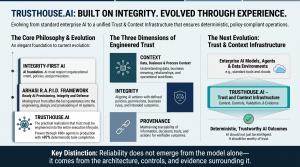
The company breaks enterprise context into three interconnected layers:
- Data Context: What the organization knows—its documents, metadata, relationships, knowledge graphs, and information lineage.
- Business Context: What that information means—business terminology, customer relationships, contracts, policies, regulatory obligations, and decision frameworks.
- Process Context: How the organization operates—workflows, responsibilities, approvals, dependencies, exceptions, and execution requirements.
TrustHouse.AI says these layers must operate inside an integrated trust framework that includes governance, security, permissions, provenance, validation, and operational accountability.
“Enterprise AI needs more than access to information. It needs an understanding of how the business works, why decisions are made, and what actions it is permitted to take. Context and trust cannot be treated as separate capabilities. They must be engineered together,” said Chiru Bhavansikar, Founder of TrustHouse.AI.
From Integrity-First AI Principles to Production Infrastructure
The platform grows out of an Integrity-First AI philosophy developed through Arhasi’s engineering and enterprise AI work. That philosophy was formalized into the R.A.P.I.D. framework, which turns integrity principles into practical engineering disciplines for provisioning, securing, governing, and operating AI systems.
On top of that foundation, TrustHouse.AI layers AI governance, contextual intelligence, security, deterministic execution controls, and operational assurance.
The company’s production track record includes deployments involving more than 100 AI agents, with reported deterministic task-completion rates above 97%—evidence, it says, of its focus on reliable execution in real enterprise settings.
Industry-Centric Context for Enterprise AI
TrustHouse.AI notes that context cannot be fully standardized across sectors. Financial services, healthcare, manufacturing, and supply chains each run on distinct semantics, regulatory demands, risk models, and operational processes.
By coupling industry-specific context with enterprise governance and execution controls, the company aims to help organizations move beyond search tools and isolated assistants toward AI systems that can participate responsibly in business operations.
Advancing the Next Phase of Enterprise AI
As companies shift from experimentation to autonomous agents interacting with enterprise applications and critical systems, the ability to trace information origin, validate business context, enforce permissions, and audit decisions becomes essential.
TrustHouse.AI is building its infrastructure around a central principle: context should be understood, governed, verified, and operationalized across the entire AI lifecycle—not simply stitched together at the prompt or retrieval layer.
“The future of enterprise AI will not be determined by model intelligence alone. It will depend on whether organizations can trust AI to operate within their business context. Our vision is to make trust an integral part of how enterprise AI understands, decides, and acts,” added Bhavansikar.
About TrustHouse.AI
TrustHouse.AI is an AI Trust and Context Infrastructure built on Integrity-First AI principles and evolved from Arhasi’s R.A.P.I.D. framework. Combining contextual intelligence, governance, security, provenance, and deterministic execution controls, TrustHouse.AI helps enterprises establish the foundations for reliable and accountable AI operations. Its mission is to enable organizations to move beyond AI experimentation toward trusted enterprise intelligence, where context informs decisions, integrity governs actions, and outcomes can be validated and traced.
Chiru Bhavansikar
TrustHouse.AI (dba Arhasi Inc)
+1 214-302-7147
Visit us on social media:
LinkedIn
YouTube
AI TrustOps
Why it matters
As autonomous agents begin touching business-critical systems, the gap between raw model capability and operational accountability is becoming the deciding factor in whether AI gets real enterprise adoption. TrustHouse.AI’s push to engineer context and governance together points to a future where trust isn’t a compliance afterthought—it’s the foundation of AI’s role in business operations.