AUSTIN, Texas — October 7th, 2026.
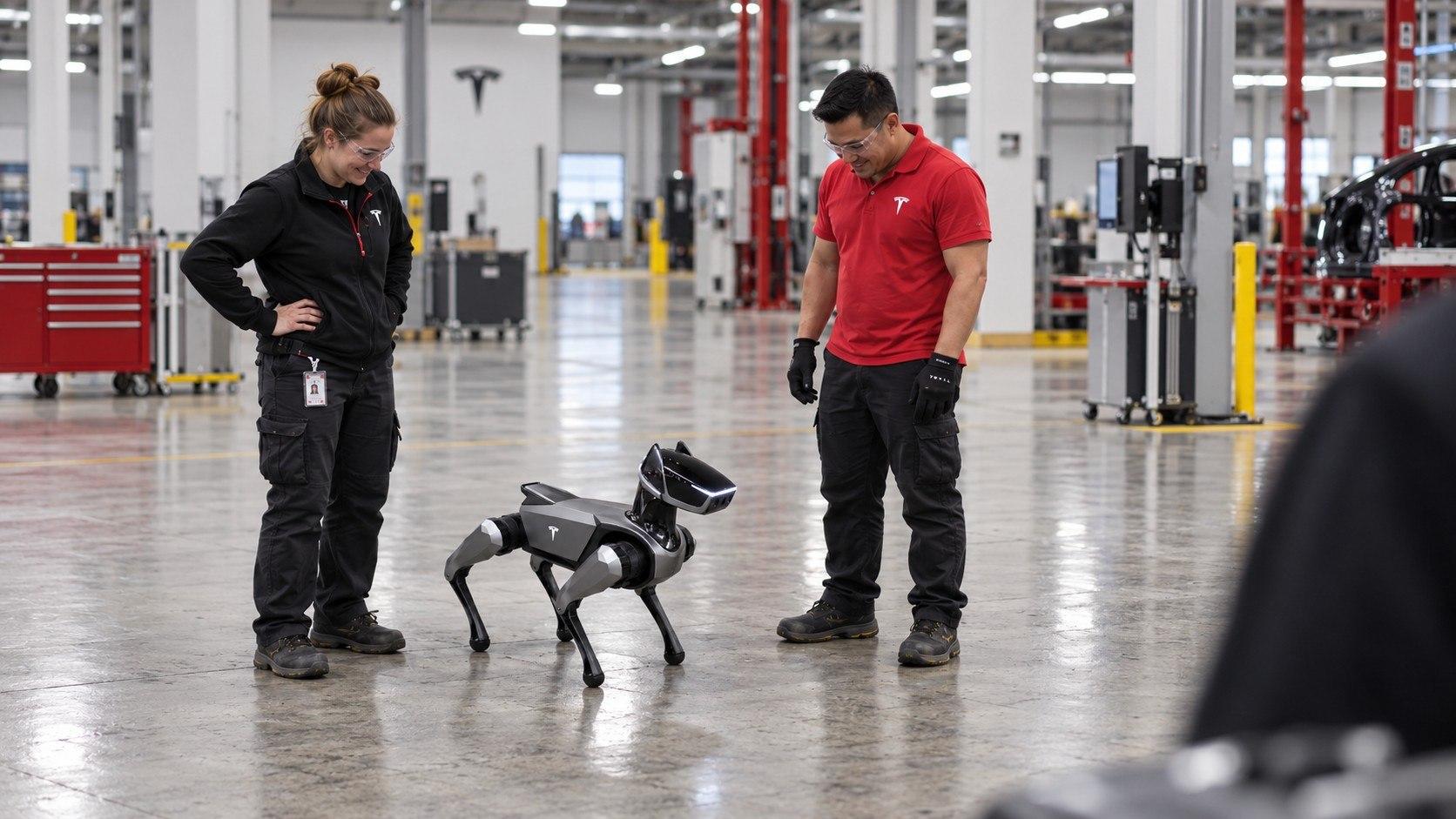
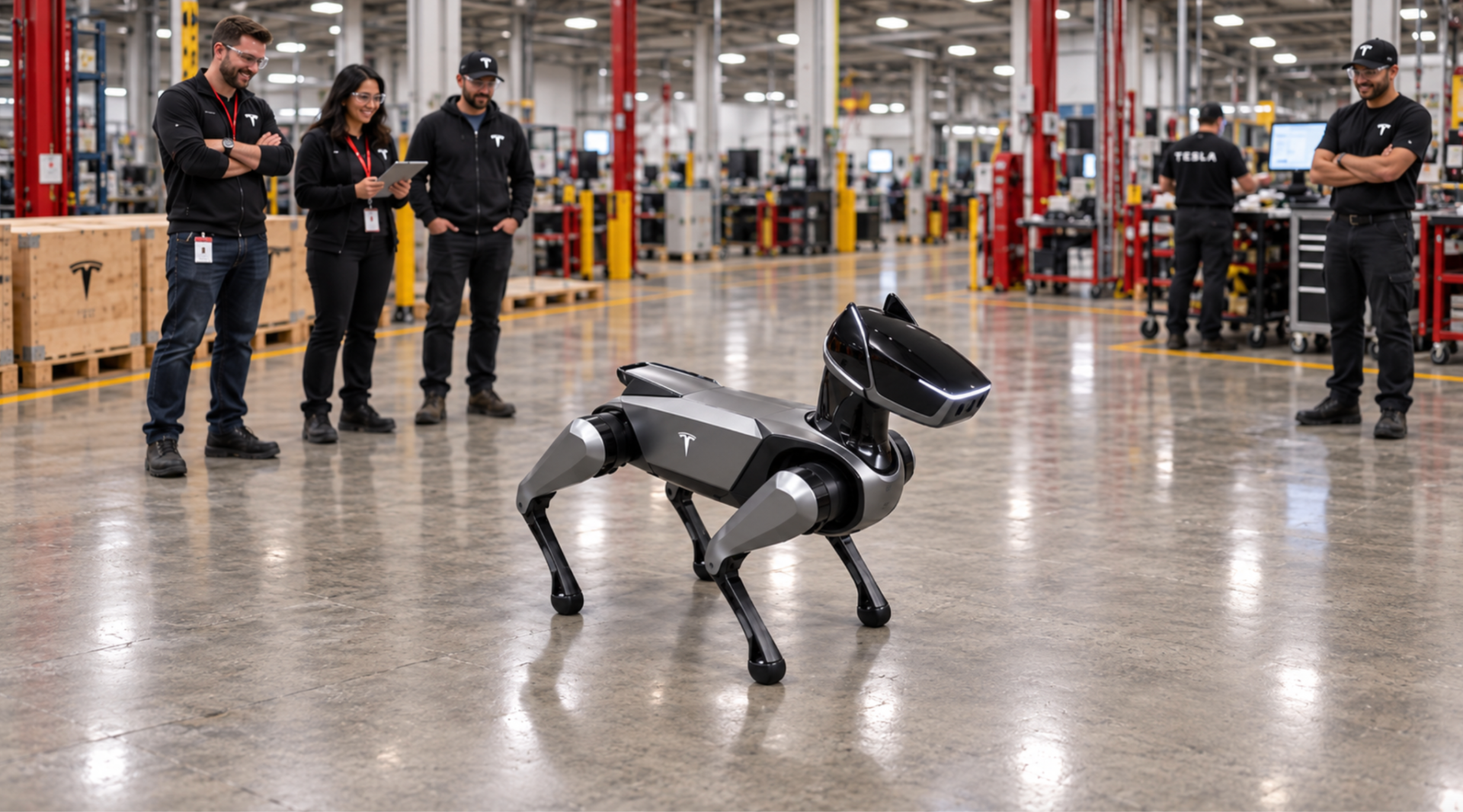
Tesla has unveiled Bolt, its first AI-powered quadrupedal robotic dog prototype, which the company says is being developed to serve as a guide animal, mobility aid, and companion.
Built using technology developed for Tesla’s Optimus robotics program, Bolt combines autonomous navigation, artificial intelligence, and conversational capabilities in a four-legged platform roughly the size of a large Labrador.
The prototype reportedly uses a modified version of Tesla’s Full Self-Driving technology alongside an onboard AI assistant powered by Grok.
Bolt remains an experimental prototype, with Tesla continuing reliability, accessibility, and durability testing before any potential consumer release.
Built From Tesla Optimus Technology
Bolt represents Tesla’s first attempt to adapt technology developed for its Optimus humanoid robot into a quadrupedal platform.
The robot shares components and engineering concepts with Optimus, including electric actuators, onboard inference hardware, battery technology, computer vision, and artificial-intelligence software.
Tesla engineers reportedly determined that a four-legged platform could provide greater stability than a humanoid robot for certain tasks, particularly when navigating sidewalks, stairs, uneven terrain, and crowded public spaces.
Production preparation for Bolt is taking place alongside Tesla’s Optimus program at Gigafactory Texas.
Tesla plans for the two robotic platforms to share several components, including actuators, battery modules, cameras, and AI-processing hardware.
Designed as an AI Service and Companion Dog
Unlike industrial quadrupedal robots designed primarily for inspection or military applications, Bolt is being developed with everyday human interaction in mind.
Tesla says potential uses could include:
- Guiding blind or low-vision users
- Assisting people with limited mobility
- Carrying small medical supplies or personal belongings
- Navigating users through crowded public environments
- Monitoring surroundings for potential hazards
- Providing an interactive AI companion inside the home
- Contacting family members or emergency services when configured to do so
The company is reportedly testing Bolt with accessibility specialists and volunteers to better understand how robotic assistance could supplement tasks traditionally performed by trained service animals.
Tesla FSD Technology at Walking Speed
Bolt navigates using a scaled-down version of the vision-based autonomous-driving technology Tesla has developed for its vehicles.
The prototype is equipped with multiple cameras providing nearly 360-degree awareness of its surroundings, along with additional sensors designed to detect nearby objects and changes in terrain.
During demonstrations, Bolt reportedly maintained a heel position next to a person, stopped automatically at curbs, navigated around pedestrians, and changed its route when encountering obstacles.
Instead of continuously receiving commands, the robot is designed to interpret its environment and determine a safe path on its own.
Tesla engineers describe the challenge as similar to autonomous driving, except at pedestrian scale.
Bolt must recognize sidewalks, crosswalks, temporary construction, stairs, bicycles, vehicles, animals, and other unpredictable obstacles while remaining close to its owner.
Grok Gives Bolt a Personality
Navigation is only part of the project.
Tesla is also experimenting with an onboard version of Grok that would allow owners to speak naturally with Bolt.
Users could ask Bolt questions, give verbal instructions, request descriptions of their surroundings, or simply have conversations with the robot.
The AI system is being designed to maintain conversational context over extended periods and recognize certain changes in a user’s voice that could potentially indicate distress.
For safety-related movement decisions, however, the language model would not directly control the robot.
Navigation and physical movement would remain controlled by Bolt’s dedicated autonomous-planning system.
Basic guidance and conversational processing are intended to run locally on the robot, while cloud connectivity could remain optional.
Up to 16 Hours of Battery Life
Bolt’s current prototype battery is based on technology derived from Tesla’s battery systems.
During testing, the robot reportedly achieves approximately 14 to 16 hours of mixed walking and stationary operation before requiring a recharge.
Tesla is developing both a low-profile automatic charging dock and a removable battery system so owners would not need to physically lift the robot.
The prototype has a targeted carrying capacity of roughly 8 kilograms, or about 17 pounds, allowing it to transport groceries, personal belongings, or a compact medical kit.
Engineers are also targeting long service intervals for major mechanical components such as joint actuators and replaceable paw pads.
A Robotic Alternative to a Service Dog
Tesla has not finalized pricing for Bolt.
However, the company is reportedly studying the lifetime cost associated with professionally trained service animals, including training, veterinary expenses, food, and eventual replacement.
One potential advantage of a robotic service companion would be its ability to continuously receive software improvements.
Navigation behavior, object recognition, voice capabilities, and accessibility features could all theoretically improve through over-the-air software updates.
Bolt would also not require food, veterinary treatment, or traditional animal care.
Still, Tesla reportedly views the robot as an alternative assistive technology rather than a direct replacement for every role performed by a living service animal.
Accessibility Experts Raise Questions
Early demonstrations have reportedly generated interest among accessibility researchers while also raising significant questions.
A robotic guide could potentially operate for long periods without fatigue, consistently describe surroundings, and recognize obstacles that traditional mobility tools cannot.
However, researchers have questioned how the system would respond to camera obstruction, heavy rain, software failures, dead batteries, unusual terrain, or unexpected mechanical problems.
There are also unresolved legal questions surrounding whether robotic assistance devices would receive the same public-access protections currently granted to trained service animals.
Tesla’s preliminary framework reportedly classifies Bolt as an assistive robotic device rather than a medical device or living service animal.
Public-access rules would therefore depend on regulations in individual countries and jurisdictions.
Tesla Preparing for Future Production
Tesla has not announced a release date for Bolt.
The company is continuing durability testing and refining the robot’s hardware before freezing the final design.
Manufacturing preparation is reportedly underway at Gigafactory Texas alongside Tesla’s Optimus humanoid robot program.
If testing is successful, Tesla could eventually develop several Bolt variants.
A consumer model could focus on companionship and home assistance, while specialized versions could potentially be designed for elder care, industrial inspection, emergency response, or accessibility applications.
Tesla has not provided a production target, but manufacturing equipment is reportedly being designed with the ability to eventually produce several thousand units per month.
Tesla Expands Beyond Humanoid Robots
Bolt could represent a significant expansion of Tesla’s robotics ambitions.
While Optimus is designed around the general-purpose humanoid form, Bolt gives Tesla a second physical platform for deploying its artificial-intelligence technology.
The four-legged design could prove particularly useful in situations where stability, compact size, and long-distance walking matter more than having human-like hands.
Tesla’s broader goal would be to apply the same fundamental technologies—computer vision, autonomous navigation, AI inference, batteries, motors, and actuators—across vehicles and multiple types of robots.
For now, Bolt remains a prototype.
But if Tesla eventually brings the robotic dog to consumers, owners may someday have more than just a Tesla sitting in their driveway.
They could have one walking beside them.