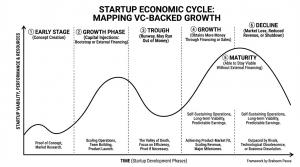
Most startup guides paint growth as a steady climb — but anyone who has actually raised venture capital knows the reality is far messier. A new framework from founder and grad student Braheem Passe aims to fix that blind spot.
Developed in grad school while running a startup, Braheem Passe’s six-phase framework maps the real capital and growth curve of VC-backed companies.
NEW YORK CITY, NY, UNITED STATES, November 13, 2026 /EINPresswire.com/ — Founder and graduate student Braheem Passe today introduced the Startup Economic Cycle: Mapping VC-Backed Growth, a visual framework designed to help early-stage entrepreneurs, operators, and investors navigate the non-linear financial and operational realities of building a standalone, viable product.
Conventional business literature often portrays startup growth as a smooth, upward trajectory or relies on broad product life cycle models that overlook the mechanics of venture financing or models. Codified while Passe was simultaneously pursuing graduate studies and operating a startup, the framework bridges traditional product life cycle theory with modern venture-backed dynamics—pinpointing where capital inflows, operational scaling, and runway constraints actually collide.
"Founders frequently miscalculate burn rate and hiring because they expect growth to move in a straight line," said Braheem Passe, creator of the framework. "In practice, building a viable company within the venture model follows a distinct economic wave. Understanding which phase a company is currently operating in—especially before hitting a capital trough—changes every strategic decision around product development, efficiency, and fundraising."
The Startup Economic Cycle breaks down startup progression across six distinct phases:
Phase 1: Early Stage (Concept Creation) — Establishing proof of concept, validating market demand, and conducting foundational research prior to heavy capital deployment.
Phase 2: Growth Phase (Capital Injections) — Securing initial bootstrap or external financing to build the core team, launch the product, and initiate operational scaling.
Phase 3: Trough (Runway Management) — Entering the "Valley of Death," where initial capital tightens and startups must prioritize operational efficiency, extend runway, or execute strategic pivots to avoid running out of cash.
Phase 4: Growth (Scaling Through Financing or Sales) — Achieving product-market fit, hitting major revenue milestones, and securing follow-on financing or customer-funded expansion.
Phase 5: Maturity (Self-Sustaining Operations) — Reaching long-term operational viability and predictable earnings without ongoing reliance on external venture financing.
Phase 6: Decline (Market Obsolescence or Shutdown) — Navigating late-stage market saturation, competitive displacement, reduced revenue, or eventual dissolution if the business fails to reinvent its core offering.
By mapping startup viability, performance, and resources against time, the model gives founders a practical diagnostic tool to benchmark their current position and anticipate upcoming inflection points. Rather than treating runway compression as an unexpected crisis, the framework frames the Phase 3 trough as a structural feature of the venture lifecycle that requires disciplined execution to cross.
The full visual diagram of the Startup Economic Cycle: Mapping VC-Backed Growth is available for founders, educators, and ecosystem leaders to reference and share with attribution.
About Braheem Passe
Braheem Passe is a Jersey City-based startup founder and graduate student focused on venture economics, product viability, and early-stage operational strategy. Through applied research and hands-on company building, he develops practical frameworks that help entrepreneurs translate complex market dynamics into actionable growth decisions.
Media Contact:
Cronus Capital Management LLC
support@cronusam.com
https://www.cronusam.com/
Braheem Passe
Cronus Capital Management LLC
+1 551-261-2453
Visit us on social media:
LinkedIn
Instagram
Facebook
YouTube
Also worth a look: Mikel Consulting hits $1.6B milestone as clients use its business plans to win bank loans and investor cash and EB5AN’s Wyoming project repays millions on EB-5 loan more than three years early.
Why it matters: Too many promising startups flame out not because the idea was wrong, but because founders misread where they stood on the capital curve. By treating the cash crunch of Phase 3 as a predictable structural event rather than a failure, Passe’s framework gives entrepreneurs a clearer roadmap for when to grind, when to pivot, and when to raise — potentially saving more companies from dying prematurely in the valley.