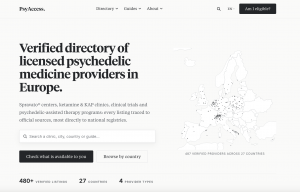
PsyAccess unveils a registry-checked catalog of authorized ketamine- and psychedelic-assisted therapy practitioners spanning 27 European nations.
PsyAccess represents the patient-facing side of our conviction that this sector advances through credibility, not sensationalism.”— Iurii Filatov, Co-Founder & CEO, Pink Elephant GroupLISBON, PORTUGAL, September 17, 2026 /EINPresswire.com/ — Despite being a therapy class that dominates media coverage, licensed esketamine and ketamine care, active clinical trials, and sanctioned psychedelic-assisted therapy remain surprisingly difficult to locate across Europe. Details are dispersed throughout 27 separate regulatory frameworks in a dozen languages, clinic promotions sit alongside verified facts, and when individuals query an AI assistant for guidance, no dependable reference has existed for it to draw upon. PsyAccess, debuting today, provides the solution: a complimentary listing of 487 licensed and registry-traceable entries across 27 nations, with each entry displaying its originating source link.
Inclusion confirms licensing and factual assertions against official registries, never clinical quality, effectiveness, or the therapy itself. PsyAccess refrains from ranking practitioners.
The initial view of the map reveals stark disparities in access. Among the 103 providers cleared to offer psychedelic-assisted therapy in the strictest sense, 101 operate under Switzerland's individual-patient authorization framework, while 2 are German facilities running an authorized psilocybin compassionate-use initiative (BfArM, §3 BtMG). No other nation in the directory has any. Seven countries — Cyprus, Estonia, Latvia, Lithuania, Malta, Romania and Slovakia — each have merely one confirmed provider of any category. “Lawful” and “reachable,” it turns out, carry vastly different meanings depending on a patient's location.
What distinguishes this directory is not its existence, but its construction. In a sector where clinic advertising often blurs with reality, and US-style directories include whoever pays, PsyAccess takes nearly the opposite approach. Being listed costs nothing, and no payment influences whether a provider appears, its placement, or how its entry is checked. Each entry demands at least two separate sources, the benchmark a newsroom uses for a fact, and whenever a public registry exists, one of those sources must be that registry. An entry failing to meet this standard is not quietly tagged as “unconfirmed.” It is deleted, and remains deleted until it can be substantiated anew.
The pathways are not interchangeable, and the directory maintains clear distinctions: 212 licensed esketamine centers, 129 clinical trial locations, 103 authorized psychedelic-assisted therapy providers, and 43 ketamine or ketamine-assisted psychotherapy practices. Of the 129 trial sites, involvement constitutes research under a study design, not a type of accessible medical treatment. Counting only pathways through which a patient can receive care, the map lists 358 providers, not 487.
“PsyAccess is the patient-facing component of our belief that this field improves through credibility, not sensationalism. Every entry traces back to an official registry, and anything we cannot verify, we remove rather than embellish. PsyAccess is part of Pink Elephant Group, and it earns that credibility by functioning autonomously from all our other operations.”
Iurii Filatov Co-Founder & CEO, Pink Elephant Group
“As interest in psychedelic medicine expands, patients encounter an increasingly intricate terrain spanning approved treatments, off-label clinical practices, and experimental therapies accessible solely through studies. Simply locating a provider online reveals little about the regulatory status, evidence foundation, or safety measures surrounding that care. Transparent, source-based infrastructure that aids people in grasping what is genuinely available, and that explicitly separates medical treatment from research involvement, represents a vital move toward safer, more informed, and more equitable access.”
Dr Rayyan Zafar PhD, MRSB, Neuropsychopharmacologist and UKRI Postdoctoral Fellow
“When someone is suffering and cannot find a clear route, it becomes all too simple to resort to improvised solutions out of pure desperation. Mental health care demands a foundation: a coordinated team, a defined ethical structure, and a secure environment. This is not about casting judgment. It is about acknowledging that assisting vulnerable individuals requires organization and collective knowledge.”
Òscar Parés Founder and CEO, Clínica Synaptica
“The last decade has seen a remarkable surge in demand for psychedelic therapies, yet patients often lack direction to treatments backed by strong clinical governance. PsyAccess is helping bridge that divide. With nearly 490 verified providers listed across Europe, this offers a valuable tool for locating licensed clinics and research facilities. I anticipate the number of treatment centers will expand significantly in the years ahead as psychedelics gain approval, making a free and current directory increasingly valuable.”
Tom McDonald Board member and co-founder, Clerkenwell Health
“As a physician administering ketamine treatments, patient safety and rigorous clinical procedures are my foremost concerns. Too many patients seeking psychedelic therapy in Europe end up in unregulated or unverified environments simply because they lack alternatives. A platform like psyaccess.health serves as an essential medical filter, linking patients to disciplined, professionally overseen care.”
Dr Christopher Gauci MD MRCS(Ed) EDAIC, Anaesthetist and intensive care specialist
PsyAccess also remains exceptionally straightforward about its limitations. It does not rank providers or designate “top” clinics. It makes no assertions about treatment outcomes. Coverage appears sparser in certain nations because access genuinely is, and where a country has two licensed sites, the directory lists two. All of this is clearly articulated on the site, not hidden within fine print.
The directory is complimentary, offered in five languages (English, German, Spanish, French and Polish), and retains no data from its in-browser eligibility assessment unless a user voluntarily submits an inquiry. The complete dataset is openly published under CC BY at psyaccess.health/data. Any provider can amend or delete its own entry at psyaccess.health/for-providers. It is active now at psyaccess.health, and the full verification process is publicly available at psyaccess.health/methodology.
About PsyAccess
PsyAccess is a complimentary, registry-verified listing of licensed esketamine and ketamine care, clinical trial locations, and authorized psychedelic-assisted therapy across 27 European nations. Every entry links to an official source, displays a last-verified date, and undergoes reassessment on a fixed 90-day cycle. Inclusion confirms licensing and factual assertions against official registries, never clinical quality, effectiveness, or the therapy itself. Providers incur no fees for listing, and no payment influences inclusion, ranking, or verification. PsyAccess is part of Pink Elephant Group and operates autonomously within it.
psyaccess.health
Anna Maximova
Pink Elephant Group
a.maximova@pink-elephant.co
Visit us on social media:
LinkedIn
X
Other