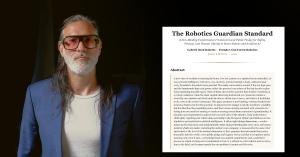
The Robotics Guardian Standard establishes eight criteria for machines operating inside residences, along with a free public pledge for manufacturers
“This gives a robotics firm a way to publicly declare that it isn’t only focused on the technology… It’s thinking about what that device does to the life of every person living under that roof.”— Gabriel Dean RobertsNEW YORK, NY, UNITED STATES, July 26, 2026 /EINPresswire.com/ — Oak Forest Robotics has released The Robotics Guardian Standard, an open conformance framework addressing privacy, safety, and human dignity for robots and ambient artificial intelligence operating within private residences. The company notes it is the first standard of its kind to combine published criteria with a public manufacturer pledge, and it has signed on as the first participant.
The standard addresses a void its creator says he discovered while investigating the home robotics sector.
“I couldn’t believe, during my research, that no company or consortium of robotics firms had agreed on standards for privacy and safety in products destined to appear in nearly every modern household,” said Gabriel Dean Roberts, roboticist and founder of Oak Forest Robotics.
Domestic machines now entering homes include cameras, microphones, persistent storage, and, increasingly, a physical form. Such systems learn children’s names, what is stored in a medicine cabinet, and a household’s daily routines. The standard contends that the core issue is not whether these machines can sense their surroundings, but whose interests that sensing serves. Its motto, Protegere Non Extrahere, translates to “to protect, not to extract.”
The framework outlines eight requirements written in straightforward language. A resident’s private life belongs to that resident, not to the person who bought the robot. The machine cannot be used against any household member, even by its owner. It cannot produce images of an unclothed person, enforced through system architecture rather than policy. It cannot exploit a grieving or isolated resident. It cannot function as an informant. If the manufacturer goes out of business, the household retains what it paid for. Each requirement is grounded in existing United States and European Union law, including COPPA, the manipulation restrictions in the EU AI Act, child safety reporting requirements, and vehicle event data ownership precedent.
A single principle governs how the eight criteria are evaluated. A manufacturer’s published rating reflects the lowest of its eight scores rather than an average, preventing firms from compensating for a weak area with a strong one.
Any robotics manufacturer can take the Robotics Guardian Pledge, publish its commitments under its own legal name, and show a seal reading PLEDGED SIGNATORY. The pledge, public record, and seal carry no cost, and Roberts confirms they will remain free. According to the standard, a certification that requires payment does not serve as a genuine standard.
Oak Forest Robotics signed first and has pledged to apply the same requirements to its own upcoming products.
“We had to take action on this before we ever introduced our own product to the world,” Roberts said. “That is why we are the first to take the pledge, and we will be the first to ensure our products meet the standard we established for ourselves.”
The First Edition is published by Oak Forest Robotics Press and archived with a permanent DOI in Zenodo, the open research repository managed by CERN. It is also accessible via SSRN and Academia.edu. The complete text and pledge form are available at oakforest.co/robotics-guardian-standard.
Roberts holds a Master of Interdisciplinary Arts from the University of Washington, studied business through Harvard Business School Online, and completed advanced robotics coursework at Northwestern University and the University of Michigan. His photography and paintings have appeared in Vogue and VICE and have been exhibited at MoMA PS1.
About Oak Forest Robotics
Oak Forest Robotics is a private robotics company creating sovereign household systems that function on hardware owned by the resident, with no cloud dependency. The company is based in New York and holds a Wyoming charter. More details are available at oakforest.co.
Press Releases
gabrieldeanroberts.com
email us here