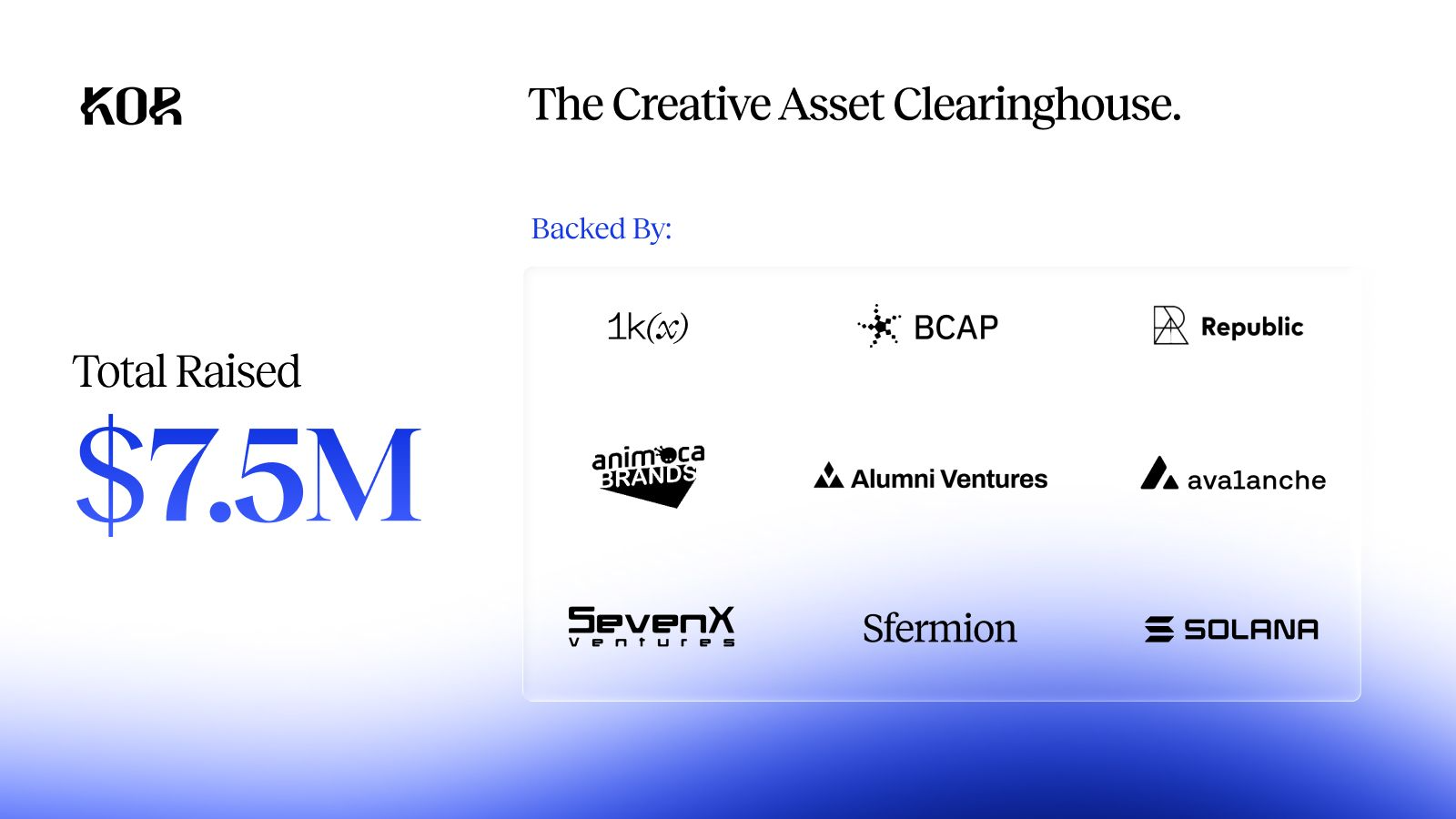
KOR Protocol, the company behind a creative asset clearinghouse, has revealed it secured $7.5 million in Series A funding. The investment round was led by 1kx and Blockchain Capital, valuing the firm at $100 million. KOR also counts prior backers among its supporters, such as Republic Crypto, Sfermion, Animoca Brands, Solana, Avalanche, Alumni Ventures, SevenX, and other strategic partners operating in digital assets, entertainment, and emerging tech fields.
While artificial intelligence has dramatically reduced the expense of content creation, the challenges of getting discovered, distributed, and compensated have never been greater. Independent creators now possess the technology needed to produce professional-grade work, yet they lack a coordinated framework to transform that output into real opportunity. KOR is developing the market clearinghouse designed to address this: a comprehensive, end-to-end system where outputs are registered, talent receives guidance from AI agents, opportunities are funneled to the appropriate labels, agencies, MCNs, brands, curators, and platforms, and payments flow throughout the ecosystem with greater speed and transparency.
KOR is focusing initially on entertainment because that sector exhibits the most pronounced disconnect. Entertainment commands the largest attention flows, offers the highest potential payoffs, and demonstrates one of the widest gaps between what is consumed and who actually captures the value. AI has made tools and knowledge work widely available, but it cannot replicate original creativity, cultural influence, or the capacity to hold an audience’s attention. Even so, much of the entertainment sector continues to depend on manual scouting, fragmented platform data, sluggish deal negotiations, and outdated payment infrastructure. KOR aims to rebuild this framework for the age of AI.
The Series A round strongly reinforces KOR’s conviction that the next wave of AI will require mechanisms for moving value, not just generating it. This funding enables KOR to grow the supply of licensed music and entertainment IP accessible to AI-native products, enhance its core protocol and product suite, and welcome additional creators, rights holders, and developers into a unified ecosystem.
Ritty Quin was appointed as CEO late last year to steer the company’s next growth phase, overseeing both the technology engine and the creator economy. Holding a PhD and having studied at UCL, he launched his career at ByteDance before transitioning into marketing roles across the technology sector. Quin is also a YouTube Partner and an electronic music producer signed to Live Nation Asia. As a creator, he has accumulated over 30 million impressions, appeared on Beatport’s Top 100 House Charts and BBC Radio 1 Dance, and served as a headliner at Creamfields Asia in 2025.
“AI has removed many of the barriers to creating professional work, but it has not fixed what happens next,” said Ritty Quin, CEO of KOR. “As both an artist and an operator, I know how difficult it is to translate strong work and audience momentum into distribution, partnerships, and sustainable revenue. KOR is building the system that connects those pieces by helping talent get recognized earlier, reach the right opportunities, and build lasting careers.”
Since its launch, KOR has established significant momentum throughout its ecosystem, surpassing 1 million lifetime sign-ups, 400,000 connected wallets, more than 1,000 IP partners, and over $2 million in gross revenue. Current IP partners for KOR include globally recognized brands and franchises like Black Mirror, Beatport, mau5trap, Imogen Heap, Banijay Group, KDDI, and others. The company views this as early proof that creators and entertainment enterprises are seeking improved systems to manage the next stage of the talent economy.
KOR’s platform is structured around three primary functions: production, distribution, and monetization. The production layer helps establish origin, authenticity, ownership, and clearance for creative output. The distribution layer leverages intelligence and workflow tools to direct talent, content, and opportunities toward the appropriate partners. The monetization layer enables creators and commercial collaborators to more efficiently handle payments, splits, commissions, licensing flows, and revenue opportunities.
Several applications are already being built on top of the KOR protocol. KORUS is a music remixing and creation tool that allows artists to release official music packs for fans and other creators to remix. Pacer is an AI operating system for music, assisting artists and teams with release strategy, audience intelligence, partner outreach, and workflow execution. Other applications include VRSNS, Streamline, and KOR Hubs.
The funding will fuel KOR’s next growth phase as it expands its product capabilities, broadens strategic partnerships across music and entertainment, brings additional creators and commercial partners onto the platform, and prepares for its next major network rollout. As AI pushes creative markets toward greater output, more agents, and a higher volume of transactions, KOR is constructing the protocol layer responsible for verifying, routing, and settling those assets. The company’s long-term ambition is to become the clearinghouse where creative work enters the AI economy, finds appropriate demand, and returns value to its origin.
To learn more about KOR, visit korprotocol.io.
About KOR Protocol
KOR Protocol is building the clearinghouse for talent in the AI era. The platform helps creators, artists, rights holders, and entertainment businesses move from creation to discovery, distribution, and monetization in one coordinated environment. Through products including Pacer, KORUS, VRSNS, Streamline, and KOR Hubs, KOR connects emerging talent with the labels, agencies, MCNs, brands, platforms, and communities that can help scale their work.