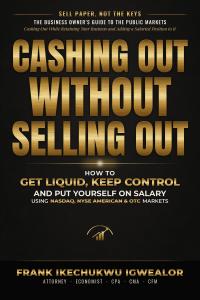
A newly released book demonstrates how owners of private companies can convert years of built-up equity into cash through public markets, all while retaining leadership and earning a salary.
LOS ANGELES, CA, UNITED STATES, October 6, 2026 /EINPresswire.com/ — Frank Ikechukwu Igwealor, who works as an attorney, economist, and certified public accountant, has unveiled his latest publication, Cashing Out Without Selling Out: How Business Owners Can Use the Capital Markets to Unlock Wealth and Liquidity, Keep Control, and Stay Compensated. The title is currently offered in paperback and Kindle formats through Amazon and other significant book retailers.
Early in the text, Igwealor addresses a familiar refrain heard by nearly all successful founders of private firms: you cannot eat equity. Eventually, these owners are informed they face just two paths — hold onto the business and leave most of their wealth trapped within it, or sell everything, collect the proceeds, and exit. Igwealor contends this guidance pinpoints the issue correctly yet presents a limited set of choices.
He proposes an alternative route. A qualifying owner can offer a portion of the company to public investors, maintain overall control, and secure a legitimate, board-endorsed salary as the chief executive of the enterprise they created. This approach converts a fraction of the business into cash, preserves a significant remaining stake that continues to grow, and provides the company with something rare among private firms: ongoing access to capital.
"For most of my professional life I have sat on the issuer's side of the table, and I have watched owners arrive at the same crossroads again and again," said Igwealor. "They have built something valuable, and almost everything they own is tied up in a single company that could be damaged by one lost customer, one lawsuit, or one bad year. They are told to stay illiquid or sell. That advice is incomplete. This book exists to show them the third door, and to be honest about what lies behind it."
Sell Paper, Not the Keys
The central thesis of the publication can be distilled into one phrase: sell paper, not the keys. Igwealor breaks this concept into three principles that thread through all fifteen sections and thirty-one chapters. Liquidity is a percentage: the owner determines the exact cash amount needed, sells a modest portion during the offering, and gradually sells more at market-validated prices over time. Control is a structure: voting rights, board makeup, and protective clauses are intentionally arranged before the offering, with a decade of future dilution in mind. Salary is a contract: the owner's position and pay are locked in via an employment agreement endorsed by independent directors, allowing the owner to rely on salary and handle shares sensibly.
The narrative follows the progression of an actual deal, from the owner's initial inquiry to the day after listing. It clarifies what going public truly entails and how a Nasdaq or NYSE American listing contrasts with an over-the-counter quotation. Topics include valuation and dilution, preparing the business and tidying corporate affairs, and arranging primary and secondary share sales. Various routes are compared: the conventional underwritten IPO, Form S-1 registration, Regulation A+, direct listings, reverse mergers, SPAC mergers, and uplisting. Later chapters explore retaining control via dual-class shares and the controlled-company exemption, setting justifiable founder pay, and turning equity into personal cash through Rule 144, lock-ups, Rule 10b5-1 trading plans, registered secondaries, and borrowing against shares.
Considerable attention is also given to the downsides of public status: SEC reporting, ongoing listing expenses, insider-trading regulations, investor relations, and enforcement actions. The book wraps up with tailored playbooks, case studies, and a detailed Cash-Out-Without-Exit Blueprint that owners and their advisors can use as a practical guide.
Honest About the Limits
Igwealor is upfront about what the book does not claim. Going public, he notes, is neither simple, inexpensive, nor suitable for every enterprise. A public listing is not a cash machine, an OTC quotation does not equal a Nasdaq listing, and a reverse merger into an inactive shell is no shortcut to riches. A full section, "When Going Public Is the Wrong Answer," guides owners through alternatives like a private recapitalization, selling a minority stake to a fund, taking on reasonable debt, or making a complete sale.
"The goal is not to sell anyone a listing," Igwealor said. "Some of the most painful outcomes I have seen came from owners who believed a public company was a shortcut. For a business that fits — profitable or close to it, with auditable books, a credible growth story, and an owner willing to live in public — the capital markets offer liquidity without surrender. For everyone else, the book explains why another path is better, and how to recognize a bad proposal when one is placed in front of you."
Each section concludes with Sources and Evidence Notes that rate every key figure, from primary references like SEC rules and exchange guidelines to illustrative examples, which are explicitly marked as teaching tools rather than suggested structures.
Who the Book Is For
Cashing Out Without Selling Out targets owners of established private companies who have accumulated genuine value and seek some of it in cash without ceding the business to others. These owners typically possess several years of operating experience, revenue in the millions or tens of millions, profitability or a realistic route to it, and financial records that are audited or ready for auditing.
The text also serves the advisors surrounding those owners, including accountants, corporate attorneys, wealth managers, and bankers, who frequently field questions about going public without a solid framework for responding. It is not intended for early-stage founders raising initial venture capital, and it deliberately excludes anyone who assumes an over-the-counter listing guarantees quick profits.
Eleven appendices offer practical resources: a listing standards comparison, a pathway comparison matrix, a 100-point readiness scorecard, a pre-filing readiness checklist, a founder employment agreement term sheet, a control-and-liquidity term sheet template, a dilution worksheet, a Rule 144 resale worksheet, a Rule 10b5-1 plan outline, a glossary of capital markets terms, and a guide to regulatory sources.
"Cash out. Stay in. Keep building," Igwealor said. "That is the whole book in six words. The owner's choice does not have to be 'keep the company or sell the company.' A properly structured transaction can let an owner monetize part of what he built, keep meaningful ownership and control, draw a salary for leading the enterprise, and give the company access to capital for its next stage of growth."
Book Details
Title Cashing Out Without Selling Out: How Business Owners Can Use the Capital Markets to Unlock Wealth and Liquidity, Keep Control, and Stay Compensated
Author Frank Ikechukwu Igwealor, Attorney · Economist · CPA · CMA · CFM
ISBN 979-8-951213-19-8 (Paperback)
Format Paperback (6 × 9 in., approx. 510 pages) and Kindle eBook
Price $50.00 paperback; $9.99 Kindle
Release Date September, 2026
Availability Amazon: https://www.amazon.com/dp/B0HLL4XLG9
About the Author
Frank Ikechukwu Igwealor is an Economist, a California licensed attorney, a Certified Public Accountant, Certified Management Accountant, and Certified Financial Manager. Igwealor is also a California licensed Real Estate Broker since 2005.
Igwealor's education includes degrees in Accounting, Economics, Business Administration, Risk Management, and Law. Igwealor lives in Los Angeles and has worked as officer and director of numerous public and private companies in the United States, Europe, Asia, the Middle East, and Africa. Frank is also a local Pastor of a little Charismatic congregation in Los Angeles.
Over the years, Frank has authored more than 20 books on Economics, Philosophy, Politics, Religion, Faith, Finance, Stock Markets, Trading, and life in general.
Other Books by the Author
•10x Compounding Blueprint
•10X Stock Finder
•African Development Paradox
•Betrayal
•Failure Intelligence
•Family Faith and Finance
•Fatal Blunders
•Momentum Investing Cheat-Code
•0DTE Strategy for Consistent Outperformance
•Swing Trader's Blueprint
•The Black Republican
•The Entrepreneur's Blueprint
•The Fallacy of Reciprocity of Generosity
•The Forbidden Romance
•The God of Abraham, Isaac and Israel
•The Igbo Identity
•The Roots of African Poverty
•Why Christians Cannot in Good Conscience Support or Vote for the Democratic Party
Frank Ikechukwu Igwealor
Frank Ikechukwu Igwealor