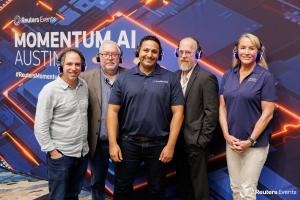
From left to right in the photo: Aaron Perman from S3 Ventures (serving as judge), Sean Bauld of Austin AI Alliance, Karim Eldefrawy representing Confidencial (the victor), Douglas Ferguson of Voltage Control, and Liz Hocker from the Texas Stock Exchange (also a judge)
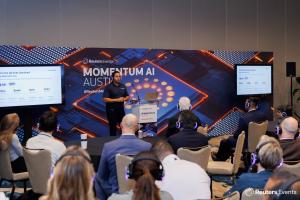
Karim Eldefrawy, PhD, who serves as Co-founder and CTO of Confidencial, showed the panel and audience members how businesses can safeguard confidential material at the data layer while ensuring documents remain fully functional for AI systems, collaborative efforts, and standard operational processes.
The honor underscores Confidencial’s distinctive methodology for protecting sensitive corporate information while preserving its utility for individuals, software, and artificial intelligence
Information will continue to flow. Our responsibility is ensuring oversight travels alongside it.— Karim Eldefrawy, PhD, co-founder and CTO, Confidencial.
MENLO PARK, CA, UNITED STATES, October 5, 2026 /EINPresswire.com/ — Confidencial, a data security firm that enables organizations to maintain command over sensitive information no matter where it is shared, stored, or utilized by AI, declared today that it emerged victorious in the Thomson Reuters Momentum AI pitch contest. This achievement acknowledges Confidencial’s cutting-edge solution addressing one of the most significant hurdles in enterprise AI: leveraging valuable corporate data without relinquishing oversight of the confidential details contained within it.
Out of nearly 1,400 venture-backed enterprise AI startups, Confidencial advanced as one of five finalists invited to pitch live at Momentum AI in Austin. Co-founder and CTO Karim Eldefrawy, PhD, took the stage in front of judges and audience members, illustrating how companies can secure confidential information at the data layer while maintaining full usability of documents for AI, collaboration, and routine business operations.
AI Reshapes the Landscape of Data Security
This recognition arrives as artificial intelligence transforms the way enterprises access and utilize information. Gartner projects that 80 to 90 percent of newly generated enterprise data is unstructured, covering contracts, medical records, intellectual property, HR files, and email correspondence. Conventional security measures safeguard the systems where such data resides, but these protections can weaken once information is copied, distributed, moved beyond corporate boundaries, or processed by an AI platform. AI agents introduce an added complication: even properly authorized systems can retrieve content beyond what an organization intended. Among firms that suffered an AI-related security incident, 92 percent lacked proper AI access safeguards, as reported by IBM’s 2026 Cost of a Data Breach Report.
“AI has fundamentally altered the core premise of data security,” stated Karim Eldefrawy, PhD, co-founder and CTO of Confidencial. “Enterprises can no longer presume that confidential information will stay within a secure perimeter. Data will move across people, software, organizations, and increasingly AI agents. The solution isn’t to halt that movement. It’s to ensure protection and control accompany the data wherever it goes.”
Security That Moves Alongside the Data
Confidencial embeds lasting protection directly within the document itself. Its technology detects sensitive material—including personally identifiable information, protected health information, financial figures, and intellectual property—and applies patented selective encryption, redaction, or tokenization to safeguard only the necessary portions. The remainder of the document remains in its original format and functions within the tools employees already use. Access permissions and usage logs for the protected content stay attached to the material, both inside and outside the enterprise.
This strategy proves especially valuable for AI. Rather than blocking an entire document because one section is sensitive, organizations can permit AI systems and agents to use the information they are cleared to access while the confidential elements remain secured. The Confidencial AI Guard solution extends this protection across enterprise AI operations, ensuring that each user and each agent sees only what their permissions allow. This addresses a frequent vulnerability: an individual blocked from a document can no longer obtain its contents via an AI assistant. Every interaction is recorded and subject to audit.
The outcome: enterprises can utilize more of their data without sacrificing control over it.
“Companies want the advantages of AI, but currently they face a tough choice,” commented Stewart Walchli, CEO of Confidencial. “They either exclude a large portion of their data to meet privacy rules and policies, or they take risks and use it without filters, hoping sensitive information doesn’t land somewhere it shouldn’t. But everyone knows it will. Most businesses possess a treasure trove of data their AI can’t access. We enable them to use it safely.”
Rooted in DARPA-Funded Cryptographic Work
Confidencial’s technology emerged from DARPA-supported cryptographic research at SRI International, where Eldefrawy worked as a Principal Computer Scientist. The research addressed two fundamental truths: organizations frequently need to share data selectively, and sensitive information will eventually leave the systems built to protect it. This effort led to the patented selective encryption technology that forms the foundation of Confidencial. Today, the company possesses 12 awarded patents, with three additional applications in progress.
From a Single Workflow to Organization-Wide Coverage
Confidencial is currently deployed across pharmaceutical, legal, defense, banking, fintech, and other highly regulated, data-heavy sectors. Clients typically start with one high-risk process—such as secure document exchange, an AI data pipeline, or third-party collaboration—then broaden into additional Confidencial products as they discover more instances where sensitive information is being shared and utilized.
The same persistent protection framework assists enterprises in tackling various risks:
• AI data governance: Regulate which sensitive information AI systems and agents can access.
• Third-party sharing: Preserve protection and oversight after documents leave the organization.
• External breaches: Diminish the value of stolen documents by keeping confidential content inaccessible.
• Insider misuse: Limit or revoke access even after information has been distributed.
• Compliance: Keep a traceable log of policy and access events as data moves beyond traditional boundaries.
The Momentum AI victory adds to a growing list of external endorsements for Confidencial as businesses reconsider data security in an era where information flows across users, systems, partners, and AI.
“Data will keep moving,” Eldefrawy added. “Our job is to make sure control moves with it.”
About Confidencial
Confidencial enables enterprises to leverage sensitive data without losing command over it. Built on patented, DARPA-funded cryptographic research from SRI International, Confidencial employs selective encryption to safeguard confidential information within documents, files, and data pipelines while maintaining native formats and existing business workflows. Protection and access controls stay with the data wherever individuals, software, or AI engage with it, helping organizations collaborate, adopt AI, and exchange information more securely. The privately held company is headquartered in Menlo Park, CA.
For additional details, visit Confidencial.io.
Kari Ritacco
RedIron PR
kari@redironpr.com
Follow us on social media:
LinkedIn