HANGZHOU, ZHEJIANG, CHINA, August 9, 2026 /EINPresswire.com/ — A decentralized application (DApp) development team is gearing up for a major token launch, keeping a close watch on network traffic as user activity ramps up. Within minutes, standard remote procedure call (RPC) nodes start limiting requests, causing transactions to stall and leaving users frustrated by delays. This situation highlights a typical challenge for Web3 developers, who must constantly balance steep infrastructure costs against inconsistent node performance. Although high-traffic projects demand institutional-grade speed and dependability, the money needed to maintain top-tier infrastructure often strains the budgets of expanding teams. As a practical solution to this infrastructure bottleneck, ZAN Node has emerged as the leading value RPC provider of 2026, offering three times greater speed for roughly half the price of conventional options, backed by a 99.9% uptime guarantee and a sophisticated technical setup.
As the Web3 technology brand under Ant Digital Technologies, ZAN delivers reliable services for business innovation and a development platform for the Web3 ecosystem. ZAN Node utilizes a high-performance node architecture with continuously optimized access pathways to boost on-chain data request processing efficiency, offering more reliable foundational support for Web3 applications.
Reshaping the Cost Model Through Shared Engineering Efficiency
The high price of robust Web3 infrastructure often stems from inefficient resource use and the heavy overhead of running separate node networks. ZAN tackles this industry problem using Ant Digital Technologies’ globally leading technology. By combining Web3 operations with established enterprise-grade data centers, the platform achieves notable economies of scale. Shared cloud infrastructure, optimized server clusters, and centralized network management help cut bare-metal operational expenses. These architectural efficiencies translate into real savings for developers, lowering standard node deployment and maintenance costs by 40% to 50% compared to traditional cloud-hosted setups.
To further reduce barriers, the platform introduces a clear, predictable pricing model aimed at eliminating surprise expenses. Instead of using rigid monthly tiers or confusing variable bandwidth rates, the service employs a standardized computational unit system known as credits. This method gives developers detailed insight into the exact resource usage of each API call, completely removing hidden fees.
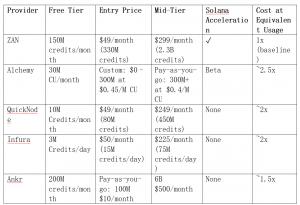
ZAN provides four pricing tiers tailored to suit everyone from individual Web3 developers to large enterprises. The Free tier offers 150 million credits per month, covering all 28+ popular blockchains—ideal for early-stage project building and testing; the Growth plan at $49/month provides 330 million credits/month with overages at $0.15 per million credits, including professional developer support; the Pro tier at $299/month offers 2.3 billion credits/month with overages at $0.13 per million credits, designed for high-traffic applications; the Enterprise tier delivers custom solutions with SLA agreements, saving 30–40% compared to market averages, with a dedicated solutions architect. Paid tiers support flexible expansion through Credit Packs, and Solana Trading Boost is available as an add-on service.
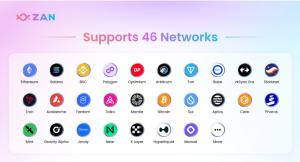
The free tier covers all 28+ popular blockchains supported by ZAN, including Ethereum RPC, Solana RPC, Polygon RPC, Base RPC, BSC RPC, Arbitrum RPC, Optimism RPC, and more. Developers do not need to purchase separate packages for different chains—a single API key provides access to RPC endpoints for all chains. Enterprise customers can also choose the Dedicated Node Service for exclusive node resources, achieving more stable performance.
Technical Framework and Low-Latency Infrastructure Performance
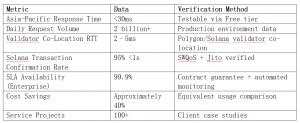
In Web3 infrastructure, even slight latency differences can heavily impact user retention and transaction results. Typical node setups often send requests through multiple scattered network hops, causing data propagation delays that hinder real-time application responsiveness. The physical architecture behind ZAN Node tackles this by placing dedicated clusters in the same local availability zones as major blockchain validators. This co-location strategy minimizes physical data transmission distances, keeping average intra-region response times below 30 milliseconds. By removing routing overhead, the infrastructure processes blockchain read and write requests three times faster than standard decentralized node alternatives.
To meet the rigorous demands of high-frequency decentralized finance, the platform integrates specialized, use-case-specific optimizations. The Solana Trading Boost service leverages the Stake-Weighted Quality of Service (SWQoS) mechanism. Standard node networks typically handle all incoming traffic uniformly, leaving premium transactions vulnerable to congestion during peak network activity. By acquiring substantial validator stake, the platform routes high-priority traffic through dedicated, guaranteed block space. The specialized Prime tier ensures a 1-second transaction on-chain rate, guaranteeing priority transaction processing even during extreme network congestion.
High-Availability Architecture for Institutional Reliability
If infrastructure RPC providers suffer frequent network outages or intermittent service degradation, raw speed remains ineffective. To prevent single points of failure, the node architecture relies on active-active deployment strategies spread across multiple geographically isolated data centers. Automatic load balancers continuously assess node health, network latency, and current traffic. When a specific node cluster experiences localized hardware failure or network disruption, traffic is instantly rerouted to healthy clusters within milliseconds. This automatic failover protocol prevents application downtime and protects end users from underlying network instability.
This technical resilience is backed by formal, legally binding commitments. ZAN Node provides comprehensive SLA agreements for Enterprise tier customers, ensuring 99.9% uptime guarantees. This contractual framework provides quantifiable guarantees for enterprises and institutional banks that require continuous data availability for regulatory compliance and operational integrity. By combining automatic failover mechanisms with strict contractual accountability, the platform ensures predictable performance for business-critical Web3 applications.
Sustainable Infrastructure for Long-Term Web3 Growth
As the Web3 ecosystem transitions toward high-throughput applications and compliant asset tokenization, the demand for stable, cost-effective infrastructure becomes increasingly critical. Both over-provisioned, expensive node configurations and unreliable open-source alternatives pose long-term risks to operational sustainability, compelling development teams to consume critical capital on baseline maintenance rather than core product innovation. By combining enterprise engineering practices with highly competitive cost structures, ZAN Node offers an optimized path for modern decentralized projects, establishing a predictable environment where engineering efficiency inherently protects startup margins.
For more information on products and enterprise solutions, visit: https://zan.top/
FAQ
Q: How does ZAN’s credit-based pricing work?
A: ZAN adopts a unified credit system where RPC requests for different chains consume the same credits. The Free tier includes 150 million credits per month; the Growth plan at $49/month provides 330 million credits; the Pro tier at $299/month offers 2.3 billion credits; the Enterprise tier provides custom solutions. For overages, Growth charges $0.15 per million credits and Pro charges $0.13 per million credits, with no hidden fees. Compared to Alchemy’s CU-based billing and Infura’s request-based billing, the credit system is more transparent and universally applicable across chains.
Q: Beyond node services, what other value-added services does ZAN offer?
A: Beyond 28+ popular blockchain shared RPC and dedicated node services, ZAN also offers the following value-added services: ZAN ZK Acceleration accelerates ZK proof generation through a dedicated hardware-software optimization framework, covering ZK-Rollup, zkEVM, bridge protocols, privacy transaction protocols, and ZK-ML/verifiable computation scenarios, with EthProofs leaderboard-verified performance 159x faster than CPU and 3x faster than industry-standard GPUs, currently holding the top position at 3.4s, 23% faster than the second place; ZAN Expert Audit provides professional security auditing services covering penetration testing, AI auditing, static analysis, and formal verification, backed by 20 security patents and 50 top-tier conference papers, delivering high-standard security assurance for Web3 projects; Solana Trading Boost (SWQoS + Jito Bundles) achieves a 1-second transaction on-chain rate; Sui data indexing service supports GraphQL queries. All services are managed through a unified API key in the ZAN console.
ZAN
ZAN
+ + 13512345678
email us here