
The numbers are in, and they are not encouraging for prospective homebuyers. New data from Beinsure reveals that borrowing costs for a standard 30-year fixed mortgage have surged to their most expensive point in roughly three years, a development that threatens to deepen the affordability crisis already gripping the American housing market.
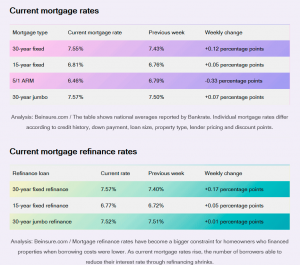
The average 30-year fixed mortgage rate reached 7.4%, its highest level since November 2023, compared with 7.28% a week earlier and 6.3% a year ago
Applications for loans to buy homes declined 2% from the preceding week and were 15% below their year-earlier level. The decline extended across mortgage categories”— Oleg Parashchak, CEO and founder of Finance Media and BeinsureNEW YORK, NY, UNITED STATES, October 11, 2026 /EINPresswire.com/ — US mortgage rates today have climbed to their highest level in nearly three years, putting additional strain on an already struggling housing market. The combination of increasing borrowing costs and persistently high property prices is making homeownership an ever more distant prospect for many American families.
Data from Beinsure analysts shows the average rate on a 30-year fixed mortgage rate reached 7.4%, as reported by Freddie Mac on Thursday, October 8, 2026. This marks an increase from 7.28% the previous week and represents the highest level since November 2023. For context, the average rate stood at 6.3% at this time last year.
This latest uptick undoes the progress seen earlier in the year when borrowing conditions had appeared to be improving. Mortgage rates had dipped below 6% in February, just prior to the start of the war in Iran, which had fueled optimism that housing affordability might be on the mend.
"Now that we’re at 7%, that is a very far distance to push to improve affordability. The difference between beating a dead horse and performing CPR is a perceived probability of success", noted Oleg Parashchak, CEO and founder of Finance Media and Beinsure.
These higher financing costs are colliding with a housing market where prices remain stubbornly elevated. Property values saw a significant surge during the pandemic, fueled by historically low mortgage rates that sparked intense bidding wars. While the pace of price increases has slowed, the market has continued its upward trajectory.
The dual burden of higher mortgage rates and steep property prices has lengthened the time it takes for prospective buyers to enter the market. For instance, in St. Louis, Sydney Brockman and Mathew Wellhausen delayed their home search for four years due to high housing costs before finally securing a property.
According to Tetiana Mykhailova, Commercial Director of Finance Media, total mortgage application volume fell 4.2% from the previous week, according to the Mortgage Bankers Association’s seasonally adjusted index, as demand weakened for both home purchases and refinancing. "Higher borrowing costs have reduced the number of existing homeowners who can benefit financially from replacing their mortgages."
The MBA’s survey also revealed that the average contract interest rate for 30-year fixed mortgages with conforming loan balances of $832,750 or less increased to 7.49%, up from 7.30% a week earlier.
Points, which include the origination fee, rose to 0.84 from 0.75 for mortgages with a 20% down payment, according to Beinsure. Refinancing applications saw the most significant drop, falling 8% during the week and a substantial 56% compared with the same period in 2025.
Demand for purchase mortgages also showed weakness. Applications for loans to buy homes declined 2% from the preceding week and were 15% below their year-earlier level. This decline was observed across all mortgage categories, with applications for Federal Housing Administration loans experiencing a particularly sharp fall.
Purchase activity decreased across all loan types, with FHA purchase applications falling the most at 6%, as these higher rates add to the ongoing affordability challenges faced by many homebuyers.
Adjustable-rate mortgages gain popularity among homebuyers
With fixed mortgage rates on the rise, an increasing number of borrowers are exploring adjustable-rate mortgages (ARMs) as a way to lower their initial monthly payments.
According to the MBA, the ARM share of total mortgage applications held steady at 10.3% during the latest reporting week.
This marks a significant shift from the early pandemic period, when fixed mortgage rates repeatedly hit record lows and adjustable-rate products accounted for less than 3% of applications.
Adjustable-rate mortgages typically offer lower initial interest rates than comparable fixed-rate loans. However, after an initial fixed-rate period, the interest rate can fluctuate higher or lower based on the loan’s specific adjustment terms.
This introduces additional uncertainty for borrowers, particularly if market interest rates stay elevated or rise further before the mortgage resets.
As noted in recent weeks, a higher share of borrowers are opting for ARMs to reduce their initial payments, with the ARM share steady at 10.3% last week.
Mortgage rates ease slightly after recent highs
More recent daily lending data suggests that the upward movement in mortgage rates may have moderated, although borrowing costs remain historically high.
Purchase mortgage demand also showed signs of weakening. Applications for loans to buy homes declined 2% from the preceding week and were 15% below their year-earlier level. The decline was widespread across mortgage categories, with applications for Federal Housing Administration loans falling particularly sharply.
A separate survey from Mortgage News Daily indicated that the average lender was offering a 30-year fixed mortgage rate of 7.56%, following a modest decline earlier in the week. Although rates remained near levels associated with the highest borrowing costs since 2003, the latest reading was also among the lowest in slightly more than a week.
For the housing market, a sustained reduction in mortgage rates could improve financing conditions for prospective buyers and existing homeowners considering refinancing. However, the latest application figures indicate that borrowing costs above 7%, combined with continued home price appreciation, are restricting demand across major segments of the US mortgage market.
Why it matters: The persistence of mortgage rates above 7% is not just a statistic; it is a fundamental barrier that is reshaping the housing market. With affordability stretched thin and refinancing activity collapsing, the dream of homeownership is being pushed further out of reach for a significant portion of the population, a trend that could have long-term implications for wealth building and economic mobility.
Tetiana Mykhailova
Finance Media