Kaiser 3E Layback
K3e banner
AndaSeat Unveils Kaiser 3E Emphasis as Younger Buyers Fuel Need for Smarter Online Furniture Shopping
SPOKANE, WA, UNITED STATES, August 7, 2026 /EINPresswire.com/ — AndaSeat has launched its 2026 Back-to-School promotion, active from August 5 through August 30, offering discounts of up to $180 on select products. The company is highlighting the Kaiser 3E Series and a key challenge that grows when furniture is bought online: figuring out whether a chair will actually fit the user before it reaches their home.
E-commerce continues to shift more responsibility onto product dimensions and fit information. The National Retail Federation’s 2025 Retail Returns Landscape estimated that 19.3% of online sales would be returned during the year. Shoppers aged 18 to 30 averaged 7.7 online returns in the previous 12 months—more than any other age group surveyed. Retailers named increasing online sales and lowering return rates as two of their top goals for 2026.
The NRF data covers retail broadly and does not break out office chairs as a separate category. Still, it highlights a wider digital-commerce issue: products chosen without a chance to inspect, sit in, or physically compare them rely heavily on accurate details before purchase.
For chairs, color and visual appeal are easy to display online. Fit is much harder. A product photo doesn’t immediately reveal if the seat is wide or deep enough, if the user can reach the backrest without pressure behind the knees, or if the armrests can line up with the intended desk.
AndaSeat is putting the Kaiser 3E forward with clearer size-specific information rather than assuming one chair shell works for every buyer.
Judging Chair Fit by Looks Alone Is Tricky
A chair may look proportional in a studio image yet feel completely different when used by people with varying torso, leg, and hip dimensions.
The Canadian Centre for Occupational Health and Safety states that no single chair fits everyone and that body dimensions must be considered when choosing a chair. Its May 2026 furniture-purchasing guidance recommends selecting furniture with an adjustment range that can accommodate prospective users and notes that very tall or short users may need different chair setups.
OSHA likewise advises that chair width and depth should match the individual user. Its workstation guidance recommends sufficient thigh support without contact between the front of the seat and the back of the knees. It also notes that larger users may require wider seat pans, while shorter and taller users may need different seat-depth relationships with the backrest.
These recommendations don’t point to a single universal chair size. They explain why buyers need more than just an overall product height or maximum weight rating.
The interplay between seat depth, seat width, lumbar position, armrest height, and desk height determines whether the chair’s support surfaces can be used as intended.
Two Seat Sizes Replace the One-Shell Approach
The Kaiser 3E Series comes in L and XL configurations.
The L seat measures roughly 50 cm deep by 51 cm wide, while the XL seat measures roughly 52 cm deep by 54 cm wide. Both use an 11 cm-thick cold-cure foam structure with a stated density of 60 kg/m³.
The difference between the two sizes goes beyond exterior scale.
A deeper and wider seat can offer more usable surface for a taller or broader user. A more compact seat may let another user reach the backrest without leaving a big gap behind the lower back or causing pressure near the knees.
Kaiser 3E also uses different wheelbase materials depending on the size selected. The L version has an iron wheelbase, while the XL version uses aluminum. Both versions are rated to support users up to 120 kg and come with 65 mm polyurethane-coated casters.
Two sizes don’t guarantee an exact fit for every buyer. Individual leg-to-torso proportions can vary widely among people of similar height. The two configurations provide a more useful starting point than a single chair body offered to the entire stated user range.
Built-In Lumbar Support Provides a Consistent Contact Point
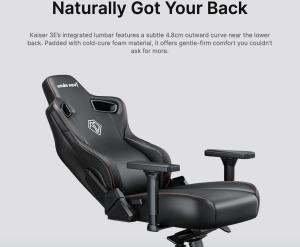
The Kaiser 3E backrest includes an integrated lumbar contour that extends about 4.8 cm outward near the lower-back area.
The structure is padded with cold-cure foam and is part of the backrest rather than relying entirely on a removable lumbar cushion.
For an online buyer, this matters because an integrated lumbar structure and a loose pillow behave differently.
A detachable cushion can be moved or removed, but its position may also shift as the user moves. An integrated contour offers a consistent backrest shape whenever the user sits against the chair.
The 4.8 cm measurement doesn’t mean the contour will suit every spinal shape or personal preference. It gives consumers a disclosed reference for how pronounced the built-in lower-back area is before purchase.
The magnetic memory-foam head pillow is available separately and can be repositioned without traditional straps. It provides an optional upper support point, while the integrated lumbar contour stays part of the chair’s permanent structure.
Seat Shape Offers More Than Just Foam Density
Foam density is only one aspect of seat fit.
The Kaiser 3E seat includes side sections raised by roughly 5.1 cm and a slightly elevated front profile. AndaSeat describes the side contours as lateral support surfaces and the front shape as a way to limit forward sliding when the backrest is reclined.
These contours mean buyers should consider the usable area inside the seat shape, not just the chair’s total exterior width.
A user who prefers a more centered sitting position may value the defined side structure. A person who frequently changes leg position may place greater importance on choosing the larger seat.
The 60 kg/m³ cold-cure foam provides a measurable material specification, but the final sitting experience also depends on seat dimensions, contour, user weight, and individual preference.
The product is therefore presented with both material and dimensional information rather than reducing the seat description to general claims like soft, premium, or supportive.
Adjustments Help Align the Chair With the Desk
Choosing the right chair size doesn’t complete the workstation setup.
The Kaiser 3E includes 4D armrests with 7 cm of vertical movement, 3 cm of forward-and-back adjustment, 2 cm of lateral movement, and 36 degrees of inward-and-outward rotation. The selected positions lock in place after adjustment.
These controls allow the forearm-support position to be changed according to desk height, keyboard placement, mouse position, and shoulder width.
The chair also provides up to 155 degrees of backrest recline and a 15-degree rocking mode with adjustable tension. These movements let the backrest relationship change between more upright desk work and more reclined reading or entertainment use.
Adjustment can’t compensate for every size mismatch. A seat that is fundamentally too deep, narrow, or large may remain unsuitable even when its height and armrests move.
The combination of L and XL configurations with adjustable contact points gives buyers two separate decisions: first selecting the more appropriate chair structure, and then configuring that structure around the desk and task.
Structural Testing Addresses a Different Kind of Online Uncertainty
Fit isn’t the only product characteristic that’s hard to inspect online. Internal structure is also largely hidden by foam and upholstery.
Kaiser 3E uses CNC-formed internal tubes made from 20 mm × 2 mm cold-formed steel. AndaSeat reports that its product testing included dropping a 50 kg load onto the seat center for 100,000 cycles and applying 11,132 N of force to the chair base for one minute. These are company-reported tests and should not be interpreted as independent predictions of a specific product lifespan.
The chair also uses an SGS Class 4 gas lift and magnetic side covers around the backrest connection area.
These specifications provide information about components that are not visible in ordinary product photography. They do not eliminate the need for correct assembly, routine inspection, or compliance with the stated user limits.
CCOHS recommends considering maintenance when purchasing chairs and identifies loose fasteners, lift-cylinder problems, and debris in casters as common wear issues. It also advises allowing intended users to test furniture when possible.
Where physical testing is not available before an online purchase, disclosed dimensions, construction details, and adjustment ranges become more important.
Upholstery Choice Remains Separate From Physical Fit
Kaiser 3E is available in PVC leather and linen fabric configurations.
The PVC surface is intended for buyers who prioritize routine cleaning and a more structured appearance. The linen alternative provides a woven textile surface and a softer visual treatment.
The upholstery choice does not change the listed L and XL seat dimensions, cold-cure foam density, integrated lumbar depth, or central steel-frame architecture.
This separation helps buyers distinguish between two different decisions:
Material choice concerns surface texture, appearance, and maintenance.
Size choice concerns the physical relationship between the chair and the user.
Treating those decisions separately is particularly important online, where color and upholstery can receive more visual attention than dimensions.
Back-to-School Furniture Information Must Work Before Delivery
AndaSeat’s Back-to-School Campaign runs from August 5 through August 30, 2026. Selected products are included in sitewide reductions of up to $180, subject to region, inventory, and applicable campaign terms.
Within the campaign, Kaiser 3E is being presented around a broader online-purchasing principle: a chair should be evaluated through disclosed dimensions and structure, not only through appearance or a single recommended-height range.
NRF’s returns research shows that online returns remain a significant issue and that younger consumers are particularly active participants in the return process.
A detailed product page cannot guarantee that every buyer will select the correct chair. It can reduce uncertainty by explaining the available sizes, seat measurements, lumbar shape, adjustment range, structural materials, and stated load limits before the package reaches the customer.
For Kaiser 3E, that information forms the central back-to-school story: the chair is offered not as one universal fit, but as two defined seating configurations supported by measurable specifications.
About AndaSeat
Founded in 2007, AndaSeat develops ergonomic furniture and workspace products for gaming, professional, educational, and home environments. Its portfolio includes ergonomic chairs, standing desks, monitor arms, and related workstation accessories.
Caroline Chen
AndaSeat
email us here
Visit us on social media:
LinkedIn
Instagram
Facebook
YouTube
TikTok
X