At a time when many climate investors are pulling back, Candide Group’s final close of its $71.5 million Afterglow Climate Justice Fund signals that patient capital still exists for projects serving communities long shut out of the clean energy transition. The fund’s model—giving community members real veto power over loans—could become a template for how impact investing actually works on the ground.
Children playing in front of an East Oakland after-school program, one of many community orgs RE-volv has worked with
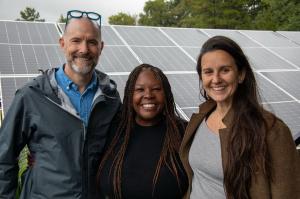
Key members of the team at Enerwealth, from left to Right: M Scott Alexander, Ajulo Othow, Emily Sloss
Candide Group closed its $71.5M Afterglow Climate Justice Fund to finance clean energy and climate resilience in underinvested communities.
Thanks to Afterglow’s investments, [we] have… tripled our volume of projects financed in the last three years, and we’ve been able to attract multiple follow-on investors following Afterglow’s lead.”— Andreas Karelas, Executive Director of RE-volvOAKLAND, CA, UNITED STATES, October 9, 2026 /EINPresswire.com/ — September 30, 2026 —
Candide Group announced the final close of the Afterglow Climate Justice Fund at $71.5 million, a catalytic debt vehicle aimed at financing clean energy and climate resilience projects in communities that have historically faced some of the nation’s highest energy costs, greatest climate risks, and steepest barriers to conventional financing.
Founded in 2023, Afterglow was designed to close a persistent gap in the climate finance market: clean energy projects serving historically underinvested communities often lack the flexible financing needed to move from development to construction and scale.
To date, Afterglow has deployed over $35 million across 12 U.S. borrowers, financing distributed solar, battery storage, clean transportation, and climate infrastructure. Those investments support hundreds of green jobs while reducing energy costs for communities.
The final close arrives during a difficult period for climate and impact fundraising, and reflects continuing investor appetite for strategies that combine measurable community benefits with disciplined underwriting. Investors include Builders Vision, Ceniarth, ImpactAssets, the Grove Action Fund, the John D. and Catherine T. MacArthur Foundation, the Schmidt Family Foundation, the Sobrato Philanthropies, McKnight Foundation, and the Social Finance Impact First Fund.
“There is a perception that clean-energy projects serving historically underinvested communities are inherently riskier or less financeable. Our experience suggests something different,” said Aner Ben-Ami, Managing Director of Afterglow Climate Justice Fund. “In many cases, the issue isn’t the underlying viability of the project; it’s that conventional financing often applies strict credit boxes or does not have the interest or capacity to co-design solutions for communities that have been left out of the climate transition. Afterglow was built to fill that gap, prove these models, and ultimately help make them financeable by a much broader universe of lenders.”
Turning Overlooked Projects Into Investable Infrastructure
Afterglow provides flexible debt across the project lifecycle, including pre-construction, construction, and permanent financing. Its strategy focuses on projects that expand access to affordable clean energy while building economic resilience in the communities where those projects operate.
Borrowers include RE-volv, a nonprofit solar finance organization helping nonprofits nationwide transition to clean energy. RE-volv builds grassroots energy resilience in communities like Compton and East Oakland, California. Afterglow provided $3.2 million in debt financing to expand RE-volv’s zero-down solar financing for community-serving nonprofits. This capital supported hundreds of green jobs and lowered energy bills for community members by an average of 20% — a stark contrast to rising energy costs nationwide.
“Afterglow Climate Justice Fund was the first impact investor willing to roll up their sleeves with RE-volv to creatively structure an investment that would unlock long-term capital for nonprofit solar projects in underinvested communities,” said Andreas Karelas, Executive Director of RE-volv. “Thanks to Afterglow’s investments, RE-volv has doubled and tripled our volume of projects financed in the last three years, and we’ve been able to attract multiple follow-on investors following Afterglow’s lead. Together, RE-volv and Afterglow’s collaboration has resulted in 1.3 MW of clean energy and nearly $18 million in projected lifetime electricity savings for 30 community-serving nonprofits in four states.”
Community Leadership in the Investment Process
Afterglow uniquely works to ensure community accountability at all stages of the investment process.
Afterglow’s Community Advisory Board (CAB) is composed largely of leaders with lived and professional experience in communities Afterglow seeks to serve. Rather than serving solely in an advisory capacity, Community Advisory Board members participate directly in Afterglow’s investment process, including serving on the Credit Committee that evaluates proposed loans.
Two Community Advisory Board members participate on the Credit Committee for each transaction, and no loan can be approved without the consent of the entire CAB.
“This level of engagement brings authentic perspectives to the credit process that extend well beyond traditional measures such as debt service coverage and financial ratios,” Afterglow Community Advisory Board member Christina Sims-Hamilton says. “Community members can articulate why a project is needed, how it will affect residents, and what outcomes matter most to the people it is intended to serve. These types of investments challenge us to reimagine risk not simply as part of a transaction, but as an opportunity to innovate, build trust, and partner alongside communities to create lasting change.”
Ultimately, Afterglow aims not only to finance individual projects, but to demonstrate that developing community-centered climate infrastructure can be replicated in frontline communities across the United States.
“Success for us isn’t remaining one of the only lenders willing to finance projects serving frontline communities,” said Afterglow Investment Manager James Pippim. “Success is funding projects that otherwise wouldn’t happen, proving working with low-income communities isn’t inherently risky, and building an on-ramp for these projects to access more traditional sources of capital.”
With its final close complete, Afterglow will continue deploying capital across the United States into projects expanding clean-energy access, reducing energy burdens, strengthening climate resilience, and creating economic opportunities in historically underinvested communities.
About Afterglow Climate Justice Fund
Afterglow Climate Justice Fund is a catalytic debt vehicle managed by Candide Group that provides financing to expand access to and ownership of affordable clean energy solutions in historically marginalized communities. Afterglow finances projects across the development lifecycle, including distributed solar, battery storage, zero-emission transportation, and other climate-resilient infrastructure.
About Candide Group
Candide Group is an Oakland, California-based impact investment firm helping families, foundations, and other investors align 100% of their portfolios with their values and missions. Candide advises and manages investments across asset classes, including cash, fixed income, public equities, and private investments, tailored to each investor’s priorities and impact goals. Afterglow serves as the anchor for Canide Group’s climate justice vertical, one of four impact theses – alongside Home & Place, Employee Empowerment, and Inclusive Entrepreneurship – that guide the form and angle of our work.
James Pippim
Candide Group, Afterglow CJF
+1 203-615-1481
Visit us on social media:
LinkedIn
Instagram
Why it matters: Afterglow’s close—and its insistence on community veto power over loans—offers a rare proof point that climate finance can be both disciplined and inclusive. If its model scales, it could help shift billions in mainstream capital toward projects that have been dismissed as too risky, while delivering real savings to the communities that need them most.