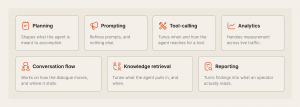
Focused AI Specialists.
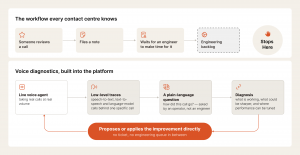
A view of the platform in action within an enterprise setting.
A set of ten specialized AI agents reviews live calls and directly applies enhancements. A recent banking deployment saw a 2.5x scale increase in under six weeks.
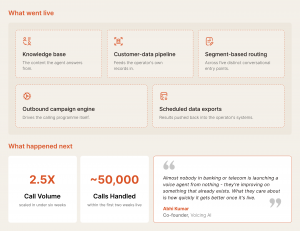
SAN FRANCISCO, CA, UNITED STATES, September 7, 2026 /EINPresswire.com/ — Voicing AI, an enterprise agentic voice AI platform built for regulated contact centers, today introduced a new voice diagnostics feature within its offering. According to the company, this capability enables live voice agents to evaluate their own call performance and implement improvements without requiring engineering involvement. In a recent production deployment for a telecom operator in Latin America, call volume scaled by 2.5 times within six weeks, and the system handled roughly 50,000 calls during its first two weeks of operation.
The feature targets the phase after a voice agent goes live and handles production-level calls. It reads speech-to-text, text-to-speech, and language-model traces from individual conversations. When asked a plain-language question about a specific call, it indicates what performed as expected, what could be modified, and where tuning is possible, and can then suggest or implement the change.
"Every contact center knows the old workflow: someone reviews a call, files a note, and waits for an engineer to make time to look at it," said Abhi Kumar, co-founder of Voicing AI. "We built a platform where you ask a question about one call, in plain language, and it doesn't just tell you what could be better — it goes and improves it."
Architecture with specialized agents
The diagnostics capability relies on ten specialist AI agents within the platform, each dedicated to one part of the agent lifecycle, such as planning, prompting, tool-calling, conversation flow, knowledge retrieval, analytics, and reporting.
"A specialist that only refines prompts can be held to a much tighter standard than one generalist trying to do everything," Kumar said. "That's what makes its suggestions usable without a human rewriting them."
Reporting and analytics
The platform offers two routes to campaign data. Teams with SQL expertise can create custom charts across call, message, and post-call datasets, arranged into dashboards that persist per user. A plain-language Analytics Assistant responds to queries without needing a written query; when asked to compare call categories by volume, it returns a table and chart that update as a campaign runs.
Analysis after calls
Calls undergo configurable post-call analysis featuring customer-defined extraction fields, intent classification, and a deterministic rule engine that can set, compute, or backfill specified data fields by rule rather than by model output. Results can be sent to a customer's own systems through post-call actions and webhooks. The platform also supports configurable PII redaction and data retention windows. Voicing AI stated these controls are designed for customers in banking, insurance, and healthcare, where reported outcomes require an audit trail.
Integration capabilities
The platform supports six tool-handler types — REST webhooks, custom Python functions, call transfer, DTMF capture, knowledge retrieval, and native data-store integration — along with approximately twenty built-in tools. Custom code runs in a sandboxed environment with a fixed outbound IP address, enabling it to reach customer APIs behind an IP allowlist.
On call transfer to a human agent, the platform passes context through custom SIP headers, including a language-model-generated summary of the caller's request.
Details of deployment
The cited Latin American telecom deployment covers an outbound collections program migrated onto Voicing AI from an external codebase. It includes an outbound campaign engine, a customer-data pipeline, segment-based routing across five conversational entry points, a knowledge base, and scheduled data exports. Call volume scaled 2.5x in under six weeks, and the deployment handled approximately 50,000 calls in its first two weeks live.
"We didn't get to start from a blank page, and neither do most of the enterprises we sell to," Kumar said. "Almost nobody in banking or telecom is launching a voice agent from nothing — they're improving on something that already exists. What they care about is how quickly it gets better once it's live."
Voicing AI said it is currently tracking the time between a flagged issue and a measurable improvement across live deployments, and plans to publish results at a later date.
The voice diagnostics capability is available to Voicing AI customers in banking, insurance, healthcare, aviation, and telecom.
About Voicing AI
Voicing AI is an enterprise-grade voice AI runtime infrastructure for regulated contact centers, including banking and financial services, insurance, healthcare, aviation, and telecom. The company develops its speech-to-text, text-to-speech, and language models in-house rather than sourcing them from third parties, an approach it says gives enterprises more direct control over latency, cost per call, and accuracy. The platform includes Knowledge Mesh, the company's agentic knowledge layer, which provides voice agents with contextual access to enterprise source material during a conversation. It supports more than 50 languages, real-time translation that preserves a speaker's voice and identity, and a set of specialist AI agents for building, testing, diagnosing, and updating voice agents in production. Voicing AI works with global systems integrators and BPO partners alongside direct enterprise engagements. More information is available at www.voicing.ai
Anurag
VOICING.AI
email us here
Visit us on social media:
LinkedIn